
Saxegothaea
Saxegothaea
Saxegothaea (Saxegothaea conspicua) belongs to the Podocarpaceae family. This evergreen coniferous tree, which resembles a yew, is native to the moderately humid forests of southern Chile and Argentina.
What the section contains

Saxegothaea
The crop prefers deep, well-drained, but consistently moist soils. It is highly sensitive to severe frost, which is why in temperate climates it can only be grown in greenhouses or in regions with mild winters.
For successful growth, Saxegothaea requires diffused light or partial shade, as direct sunlight can burn the young needles. The plant does not tolerate waterlogging, so when planting in heavy soil, it is essential to provide a high-quality drainage layer.
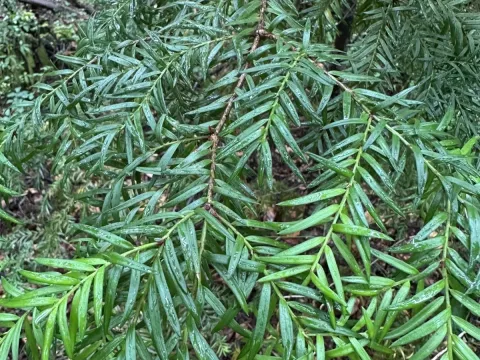
In its natural habitat, the tree can reach a height of up to 20 meters, featuring a dense crown with drooping branches. The leaves of Saxegothaea are linear-lanceolate, leathery, dark green on the top, with visible stomatal bands on the underside.
Propagation is primarily carried out via seeds or cuttings in greenhouse conditions. Rooting cuttings is a lengthy process that requires strict control over substrate moisture and air temperature.
Although Saxegothaea is not a typical agricultural crop for mass production, its wood is highly valued in forestry. It possesses excellent strength and resistance to decay, making it a sought-after material for fine woodworking.
Timber harvesting is only conducted within the framework of sustainable forest management, as the tree's slow growth rate limits industrial exploitation. For decorative purposes, the plant is used to landscape parks and gardens in mild climates.
Seed collection for nurseries is done manually in late autumn when the cone-berries attain their characteristic color. It is important to harvest on time to prevent damage to the seeds by birds.
Maintenance of the stands includes sanitary pruning, which is performed during the dormant season. This helps to shape a healthy crown and remove damaged or diseased branches that hinder the tree's proper development.
Economically, Saxegothaea is considered a valuable introduction for botanical collections and specialized wood farms focused on producing high-quality, exclusive timber.
The primary threats to Saxegothaea are fungal root diseases, which occur due to soil saturation. Regular aeration and careful irrigation management help minimize the risks of root rot.
Among pests, aphids and spider mites pose the greatest danger to young seedlings. These insects feed on the sap of the needles, which, if left unchecked, can lead to the wilting of individual shoots.
To prevent pest infestations, it is recommended to conduct preventive spraying with biological insecticides during the spring season. The use of chemical protection should be strictly measured and targeted.
The crop is negatively affected by sharp temperature fluctuations and strong, drying winds. Providing wind protection through hedge plantings is a necessary agrotechnical measure for young plants.
Monitoring the condition of the needles allows for the timely detection of infection sites, enabling intervention before the spread of the disease across the entire tree.