
Salt-marsh popcornflower
Plagiobothrys salsus
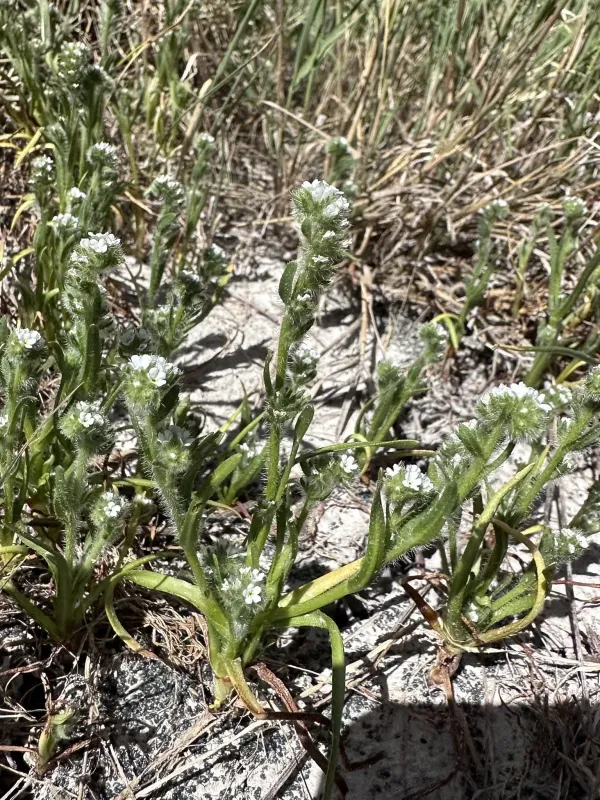
Description
Growing requirements
Salt-marsh popcornflower (Plagiobothrys salsus) is an intriguing plant species belonging to the Boraginaceae family. It is classified as a halophyte, an organism that thrives in environments with high salinity levels, which would be lethal to most conventional crops.
Native to the arid regions of the Western United States, particularly Nevada and Oregon, this plant is naturally adapted to alkaline deserts and the edges of salt lakes. Its evolutionary history has endowed it with specific mechanisms for ion sequestration, allowing it to maintain osmotic balance.
Botanically, this is an annual herb characterized by a compact growth habit and silver-hued foliage. Its leaves are covered in fine, trichome-like structures that reflect excess sunlight and reduce evaporation, which is a critical adaptation for its survival in desert landscapes.
For successful cultivation, the crop demands well-drained, saline soils with a high alkaline pH. It thrives in open field conditions where direct solar radiation is maximized, as light intensity is directly linked to its metabolic efficiency and development stages.
Economically, the plant is primarily evaluated for its potential in soil restoration and as a model organism for genetic research in salt tolerance. Utilizing this species can help stabilize degraded saline soils, preventing erosion and providing a foundation for ecosystem recovery.
Main diseases and pests
The primary threats to the cultivation of Plagiobothrys salsus revolve around hydrological management. Excessive moisture in the root zone is detrimental, often leading to rapid decay, as the plant is evolved to deal with concentrated solutes rather than high water pressure.
Pests typical for this species in the wild include migratory insects and local desert fauna, though their impact is usually negligible in controlled field trials. However, during the seedling phase, the crop remains vulnerable to standard field pests if not protected by initial barriers.
Weed competition is a significant threat during the establishment phase. Because Plagiobothrys salsus grows relatively slowly at the start, it cannot easily compete with faster-growing invasive weeds, requiring manual or selective mechanical weeding in the first weeks.
Pathogenic risks are relatively low, but soil-borne pathogens like Pythium can affect the roots if the irrigation regime is poorly managed. Ensuring good soil aeration is vital to mitigate the risk of fungal proliferation under high salinity conditions.
Nutrient deficiency is another challenge. While the plant is salt-tolerant, it still requires essential micronutrients to complete its reproductive cycle. In highly saline environments, these nutrients are often "locked," necessitating precise foliar application to maintain healthy crop development.