
Parinari anamensis
Parinari anamensis
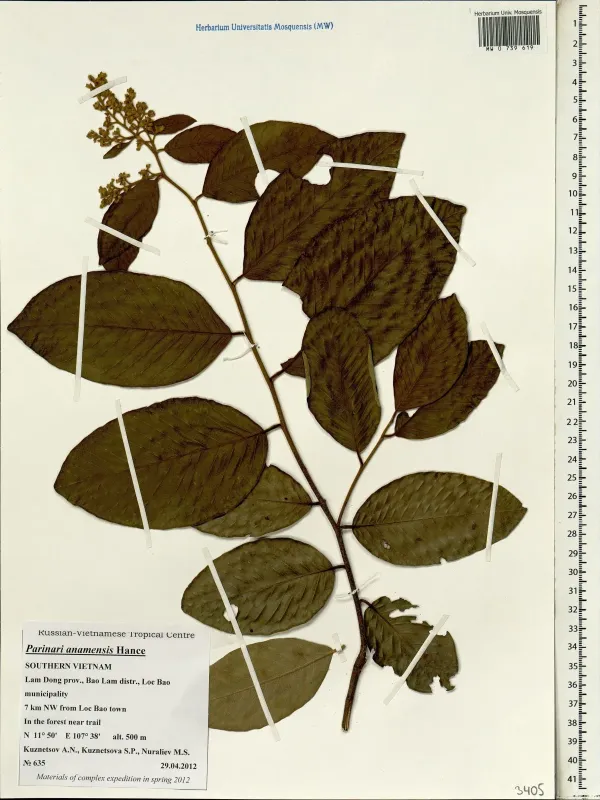
Description
Sowing dates
Propagation of Parinari anamensis is primarily achieved through seeds. For the best germination rates, seeds should be sown immediately after collection, as their viability decreases significantly when stored for prolonged periods.
In nursery settings, seeds are planted in well-draining containers using a medium enriched with organic matter. Proper depth, usually about 2–3 centimeters, is essential to ensure healthy root development during the early stages.
Maintaining a stable temperature between +25…+28 °C is crucial for successful germination. Consistent soil moisture must be maintained, but over-saturation should be avoided to prevent seed rot before emergence.
Young seedlings require moderate shade during their initial growth phase to protect them from intense tropical sun. They are typically ready for transplanting to their permanent site once they reach a height of 30–40 centimeters.
While vegetative propagation through cuttings is a theoretical possibility, its low success rate makes seed propagation the standard practice for agricultural cultivation of this species.
Growing requirements
Parinari anamensis is a member of the Chrysobalanaceae family, characterized as a tropical evergreen tree. It thrives in regions with high humidity and stable, warm temperatures throughout the year.
The tree adapts well to various soil types, provided the drainage is excellent. It is particularly sensitive to waterlogged conditions, which can lead to severe root health issues and inhibit overall development.
Full sun exposure is a fundamental requirement for the healthy growth and high productivity of this tree. Insufficient light levels often lead to sparse canopy development and reduced fruit yields.
While the tree shows some tolerance to short dry spells, supplemental irrigation is necessary during the flowering and fruit-setting stages to ensure optimal quality and quantity of the harvest.
The ideal climatic conditions involve a frost-free environment with minimal temperature fluctuations. Exposure to cold or frost is detrimental and can lead to the death of the tree, limiting its range.
Yield
The yield of Parinari anamensis is heavily dependent on tree age, site quality, and the level of horticultural care provided. Mature trees, when properly managed, provide reliable annual harvests of useful fruits.
These fruits are utilized in various culinary applications, including fresh consumption and local food processing. The sugar content and flavor profile depend on optimal sunlight and adequate hydration.
Systematic pruning is recommended to maintain a manageable tree height and density. This improves harvest efficiency and encourages a balance between vegetative growth and reproductive fruit production.
The harvest season is typically distinct, requiring efficient logistics for storage and transport. Following correct post-harvest technology is essential to prevent rapid degradation of the fruit quality.
Planting density should be carefully calculated to avoid competition for resources. Adequate spacing allows each tree to reach its full yield potential while facilitating maintenance tasks in the orchard.
Main diseases and pests
Fungal diseases are the primary threats to Parinari anamensis, particularly in high-humidity environments. These pathogens can affect leaves, branches, and occasionally the bark, weakening the plant.
Wood-boring insects represent a significant risk, as they penetrate the bark and internal structure, often inviting secondary bacterial infections. Regular monitoring is necessary for early detection.
Root rot is a major concern in orchards with poor drainage. Proactive soil management, including the addition of organic amendments and proper contouring, helps prevent soil-borne pathogen outbreaks.
Leaf-eating pests may affect juvenile trees, slowing their establishment. Implementing integrated pest management strategies using biological controls is highly recommended to maintain orchard health.
Promoting good airflow throughout the tree canopy via proper pruning significantly reduces the risk of fungal proliferation and improves the overall resilience of the tree against common tropical pests.
Harvesting
Harvesting Parinari anamensis fruit is performed manually to preserve the integrity of the skin and flesh. Fruits should be picked only when they reach the desired maturity index for the intended use.
The harvesting process is selective, as fruit may ripen at slightly different times on the same tree. This requires multiple passes through the orchard during the peak season to collect fruit at its best.
Post-harvest handling must be swift, focusing on temperature control and ventilation. Keeping the fruit cool helps maintain its freshness and nutritional value during transit to local markets or facilities.
Using protective packaging materials, such as cushioned trays or ventilated crates, is critical during transport to prevent bruising and physical damage that could accelerate spoilage.
Efficiency in the supply chain is vital, as the fruit has a relatively short shelf life at tropical ambient temperatures. Proper coordination between the orchard and the end-user ensures maximum quality delivery.