
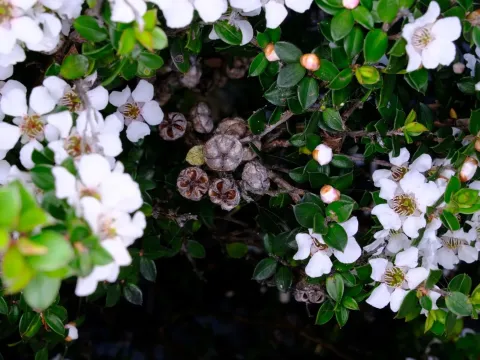
Leptospermum
Leptospermum
Leptospermum is a genus of evergreen shrubs and small trees belonging to the Myrtaceae family. Commonly known as tea trees, these plants are native to Australia, New Zealand, and parts of Southeast Asia.
What the section contains
 Creeping Leptospermum
Leptospermum humifusum
Creeping Leptospermum
Leptospermum humifusum
 Large-flowered tea tree
Leptospermum grandiflorum
Large-flowered tea tree
Leptospermum grandiflorum
 Leptospermum arachnoides
Leptospermum arachnoides
Leptospermum arachnoides
 Leptospermum barneyense
Leptospermum barneyense
Leptospermum barneyense
 Leptospermum continentale
Leptospermum continentale
Leptospermum continentale
 Leptospermum deuense
Leptospermum deuense
Leptospermum deuense
 Leptospermum grandifolium
Leptospermum grandifolium
Leptospermum grandifolium
 Leptospermum hybrid
s
Leptospermum hybrid
Leptospermum hybrids
 Leptospermum juniperinum
Leptospermum juniperinum
Leptospermum juniperinum
 Leptospermum morrisonii
Leptospermum morrisonii
Leptospermum morrisonii
 Leptospermum myrtifolium
Leptospermum myrtifolium
Leptospermum myrtifolium
 Leptospermum petraeum
Leptospermum petraeum
Leptospermum petraeum
 Leptospermum squarrosum
Leptospermum squarrosum
Leptospermum squarrosum
 Leptospermum wooroonooran
Leptospermum wooroonooran
Leptospermum wooroonooran
 River tea tree
Leptospermum riparium
River tea tree
Leptospermum riparium
 Rock tea tree
Leptospermum rupestre
Rock tea tree
Leptospermum rupestre
 Shining tea tree
Leptospermum nitidum
Thompson's leptospermum
Leptospermum thompsonii
Shining tea tree
Leptospermum nitidum
Thompson's leptospermum
Leptospermum thompsonii
 Woolly tea tree
Leptospermum lanigerum
Woolly tea tree
Leptospermum lanigerum
Leptospermum
The botanical structure of the plant features small, often aromatic leaves and a dense display of flowers with five petals. It thrives in temperate climates and is widely recognized for its high adaptability to different environments.
Successful cultivation requires full sun exposure and well-drained soil. They are particularly sensitive to poor drainage, which can quickly lead to root rot; thus, elevated planting sites or high-quality drainage substrates are recommended.
Leptospermum prefers acidic soils and is generally intolerant of heavy, alkaline, or lime-rich ground. Proper irrigation management is essential, as the plants need consistent moisture but cannot tolerate waterlogged conditions.
Economically, this crop is vital for the production of Manuka honey and specific essential oils, making it a valuable agricultural commodity in regions where it is cultivated commercially.
Common fungal diseases that threaten Leptospermum include powdery mildew and various types of root rot, which are primarily caused by insufficient air circulation and excessive humidity levels.
Pests such as spider mites and scale insects are the most significant threats to the foliage and stems. These pests thrive in dry environments and can severely stunt the growth of the plants if left unchecked.
Effective management includes regular monitoring and pruning to ensure the internal canopy remains open for adequate airflow, which is a critical practice for reducing fungal risk.
When chemical intervention is required, growers should select targeted pesticides that are compatible with integrated pest management programs to protect beneficial pollinators.
Strict sanitation practices, such as the removal of infected plant debris from the fields, are essential to prevent the spread of soil-borne pathogens and to maintain healthy crop yields.