
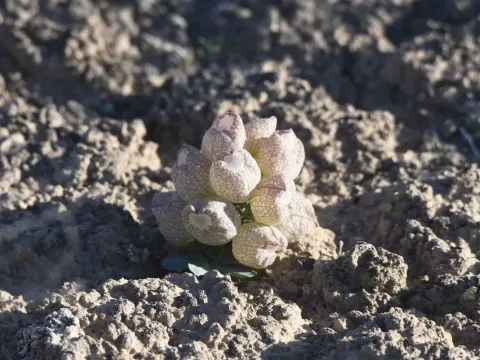
Leontice
Leontice
Leontice, a member of the Berberidaceae family, is a herbaceous perennial characterized by its large, starch-rich tuberous root. Propagation is primarily achieved through seeds, which require specific environmental conditions to germinate effectively.
What the section contains


Leontice
For successful cultivation, seeds should be sown outdoors in the late autumn. This allows the seeds to undergo natural stratification during the winter months, which is essential for breaking dormancy and ensuring high germination rates in the spring.
Tuber planting should be conducted during the plant's dormant period, typically in late summer. Care must be taken to ensure the tubers are placed in well-draining soil, as any damage to the skin can lead to rot during the wetter seasons.
Spacing is critical for the development of healthy tubers. Plants should be set at least 25-30 cm apart to prevent root competition and to ensure adequate air circulation around the crown of the plant.
The planting substrate should be light, sandy, and porous. In controlled environments, avoid heavy fertilizers during the initial planting phase, as the plant is adapted to nutrient-poor soil types characteristic of its native habitats.
Leontice is biologically classified as a steppe ephemeral, meaning it is adapted to short, intense growing seasons followed by long periods of dormancy. It thrives in regions with sharp temperature fluctuations.
The most important requirement for Leontice is soil drainage. It is naturally resistant to drought but highly susceptible to waterlogging. The soil must be sandy or gravelly to ensure that excess moisture drains away from the tubers.
Full sun is non-negotiable for this species. It is a light-loving plant that requires maximum daily exposure to solar radiation to produce the sugars necessary to sustain the tuber through the dry season.
The optimal climate mimics that of Eurasian steppes and semi-deserts. It requires a cold, moisture-rich winter for breaking dormancy, followed by a dry and warming period to stimulate flowering and subsequent foliage senescence.
The soil pH should be kept within the neutral to slightly alkaline range. High salt tolerance is a feature of this plant, making it suitable for areas where other crops might struggle due to high mineral content in the soil.
Root rot caused by fungal pathogens remains the primary threat to the health of Leontice plantations. This is usually triggered by inadequate drainage or irrigation practices that leave the soil too damp for extended periods.
Soil-dwelling insects, particularly wireworms, present a significant danger as they tend to feed on the interior of the fleshy tubers. Preventive soil treatment is recommended if these pests are known to be present in the area.
Powdery mildew can occur if the plant is grown in areas with poor ventilation or high relative humidity. Maintaining proper spacing between plants and ensuring a dry microclimate helps in managing this disease.
Rodents, including voles and mice, often target the energy-dense tubers during the winter dormancy period. Physical barriers, such as underground wire meshes, are the most effective means of protecting the crop.
Monitoring the foliage for early signs of disease is essential, as the rapid growth cycle of the plant allows little time for intervention once an infection has taken hold of the main tuber system.