
Green kyllinga
Kyllinga brevifolia
Description
Growing requirements
Green kyllinga (lat. Kyllinga brevifolia) is a perennial sedge belonging to the family Cyperaceae. Often regarded as a persistent and invasive weed in agricultural and horticultural settings, it is recognized for its ability to form dense, mat-like colonies that can rapidly displace desired turf grasses or crop seedlings.
Originating in tropical and subtropical regions, the species has a wide global distribution. It thrives in moist, disturbed environments, such as irrigation ditches, wet pastures, and riparian zones. Its ability to tolerate periodic saturation makes it particularly problematic in lowland farming areas and poorly drained landscapes.
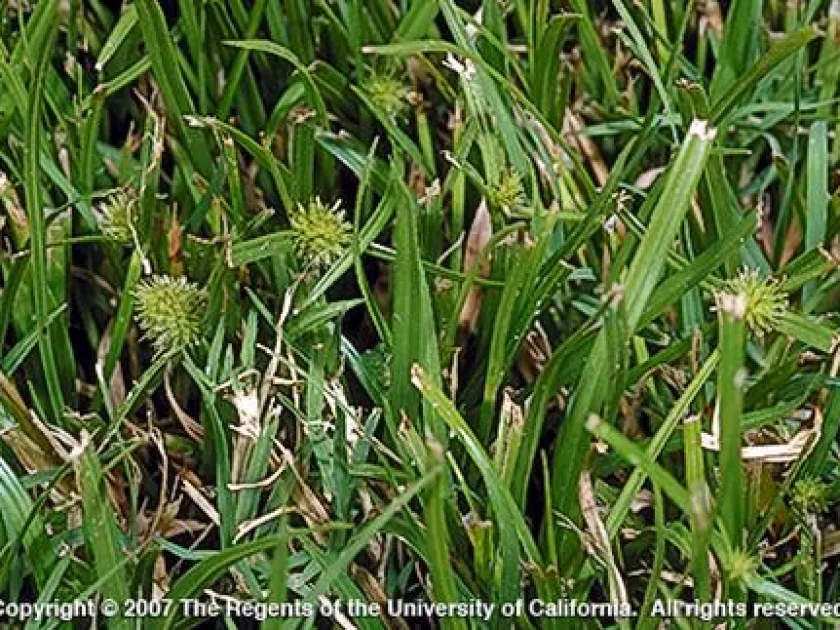
Botanically, it is characterized by its creeping rhizomatous growth habit, which allows it to spread laterally with high efficiency. The culms are triangular, reaching heights of 5 to 30 cm, and are accompanied by grass-like, linear leaves. The most distinctive feature is the terminal, globular-shaped flower spike, typically pale green, supported by several leafy bracts.
The environmental requirements for this plant focus heavily on soil moisture and ambient humidity. While it can adapt to various soil textures, it shows a strong preference for damp, nutrient-rich soils. It does not possess a significant period of dormancy in warm climates, allowing it to maintain vegetative growth year-round if temperatures remain conducive.
Management requires an integrated approach. Because of its rhizomatous system, simple mowing or shallow cultivation often stimulates rather than reduces its growth. Effective control typically involves deep tillage to dry out the rhizomes or the precise application of systemic herbicides. Early identification is crucial, as the weed can become virtually impossible to eradicate once it forms a dense, mature turf mat.
Main diseases and pests
The primary natural threats to this species include fungal infections such as leaf spots, which can reduce photosynthetic efficiency. Additionally, various species of beetles and stem-boring insects have been documented to feed on its tissues. In agricultural environments, however, these biological factors are rarely sufficient to suppress the plant significantly, necessitating human intervention for control.