
Kallstroemia intermedia
Kallstroemia intermedia
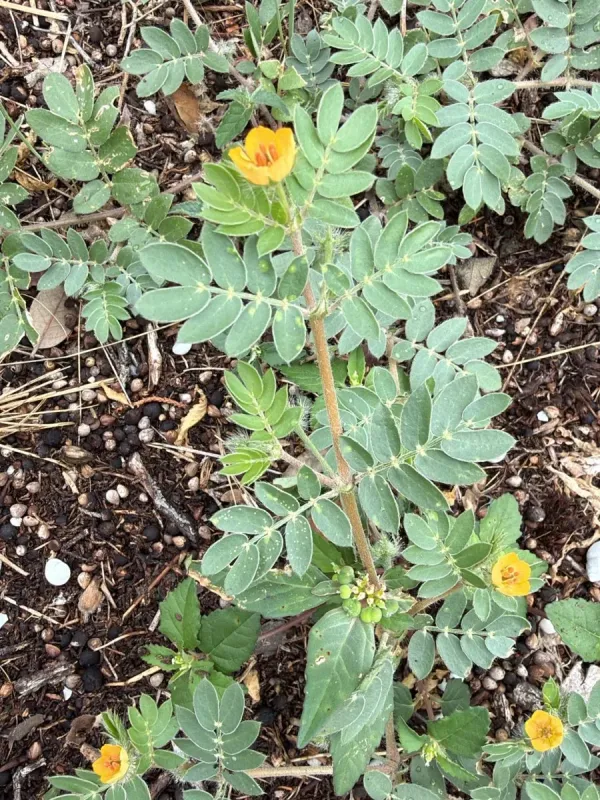
Description
Growing requirements
Kallstroemia intermedia is an annual herb belonging to the Zygophyllaceae family. It is characterized by its prostrate, spreading stems and distinctive five-petaled yellow flowers, commonly known for its resilience in harsh environments.
Native to the arid and semi-arid regions of North America, particularly the Southwestern United States and Mexico, this species thrives in dry, sandy, or gravelly soils. It typically colonizes disturbed areas such as roadsides, grazing lands, and uncultivated fields.
In terms of agricultural status, Kallstroemia intermedia is not a crop but is classified as a ruderal weed. It often emerges in areas where crop competition is low, exploiting soil moisture during the peak heat of the summer months.
The plant demonstrates extreme xeric adaptations, allowing it to complete its life cycle rapidly following minimal rainfall. This drought-tolerance mechanism makes it a persistent inhabitant of arid agricultural landscapes.
While the plant has little to no commercial value, it is of interest in botany and ecology. Researchers study its physiological traits to understand better the mechanisms of drought tolerance that could be applied to breeding resilient agricultural crops.
Main diseases and pests
The primary threats to Kallstroemia intermedia populations are excessive soil moisture and flooding, which the plant is not evolutionarily equipped to handle. Prolonged saturation often leads to root decay and fungal infections.
Insects such as leaf-eating beetles can occasionally cause damage to the foliage. These pests typically have a negligible impact on the overall population density due to the plant's high regenerative capacity.
Fungal diseases like powdery mildew can affect the plant in unusually humid conditions, significantly weakening its growth. However, this is rare in its native desert range.
Agronomic control is primarily achieved through mechanical cultivation. Disrupting the soil surface before the plant sets seeds is the most efficient strategy for preventing its spread in agricultural plots.
Since the species is adapted to low-nutrient environments, it remains highly competitive in poor soils, making it a persistent concern for land managers in dryland farming regions.