
Farsetia jacquemontii
Farsetia jacquemontii
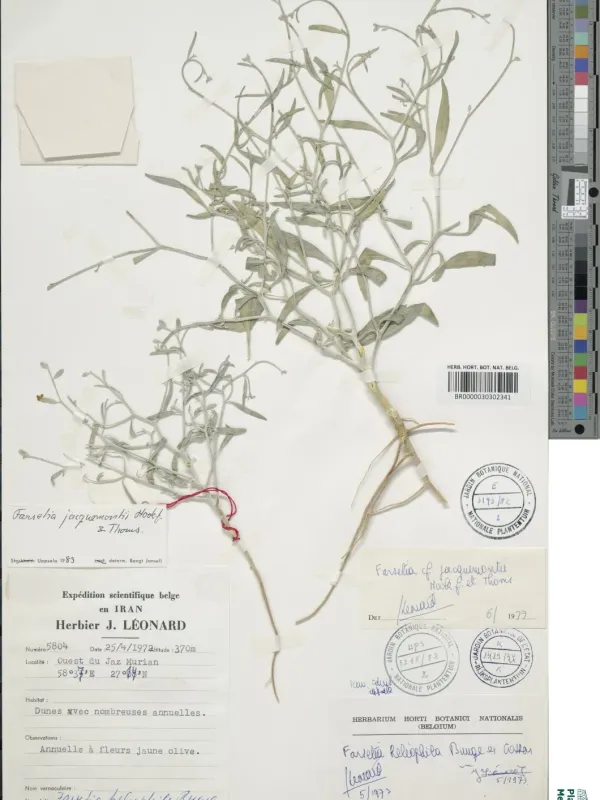
Description
Sowing dates
Farsetia jacquemontii is a perennial subshrub belonging to the Brassicaceae family. It is naturally adapted to arid environments, where it serves as a resilient component of desert and semi-desert vegetation.
Sowing should be synchronized with the onset of the rainy season to ensure optimal moisture for seed germination. The seeds are typically sown at a shallow depth of 1-2 cm to facilitate quick emergence.
Soil preparation is essential for successful establishment. It involves loosening the topsoil to allow the taproot, which is vital for the plant's survival in dry conditions, to penetrate deep into the ground.
During the initial stages of cultivation, weed control is crucial. Since Farsetia jacquemontii grows slowly at the beginning, competing weeds can easily stifle its development and limit its access to water.
Proper spacing is recommended to ensure each plant receives sufficient sunlight and nutrients, especially in areas where resource competition is naturally high due to the lack of rainfall.
Growing requirements
This crop is highly adapted to extreme heat and prolonged drought. It thrives in regions with high solar radiation and is rarely affected by the intense desert sun that would wilt many other agricultural species.
Farsetia jacquemontii prefers light, sandy, or gravelly soils with excellent drainage. It cannot tolerate waterlogging, which often leads to root decay and the eventual death of the plant within a short period.
The plant demonstrates good tolerance to alkaline and slightly saline soils, making it a potential candidate for the remediation of degraded lands in arid and semi-arid climates.
Minimal moisture is required once the plant is established. Its physiological adaptations allow it to maintain cellular turgor even during extended rainless periods, which is its main evolutionary advantage.
Fertilization needs are relatively low compared to high-yield industrial crops. Supplemental phosphorus and potassium can enhance root architecture and biomass production, particularly in poor desert soils.
Yield
The primary agricultural use of this plant is as a source of fodder for livestock, particularly camels, goats, and sheep. Its biomass provides essential nutrients during the dry season when other forage is unavailable.
Yield levels depend heavily on seasonal precipitation. In managed agricultural settings with supplementary irrigation, the plant can produce significantly higher biomass per hectare than in its wild state.
The seeds are a valuable by-product and have been studied for their oil content. While not yet a major commercial oilseed crop, its potential for utilization in specific niche markets continues to be researched.
The plant has a strong capacity to regenerate after grazing. This allows it to be used in managed pasture systems, where controlled rotational grazing can maintain the stand over many years.
Yield optimization requires careful observation of the growth cycle. Harvesting at the peak of vegetative development ensures the best balance between biomass quantity and nutritional value for animal feed.
Main diseases and pests
Farsetia jacquemontii is naturally resistant to many pests due to the presence of secondary metabolites, such as glycosides, in its tissues. This makes it an ideal candidate for low-input or organic farming.
The main threats to the plant are soil-borne pathogens, particularly Fusarium species, which can cause root rot if the soil moisture levels remain too high for extended periods of time.
In some regions, foliage-feeding insects, such as flea beetles, can damage young seedlings. Vigilance during the early growth stages is necessary to protect the stands from significant early-season loss.
Weed encroachment remains the primary non-biological threat. Dense weed cover can lead to shade, which significantly reduces the growth rate and increases the plant's susceptibility to other pathogens.
Sustainable cultivation practices, including proper crop rotation and the use of healthy, high-quality seeds, are essential to mitigate the impact of diseases and maintain high overall yields.
Harvesting
For fodder purposes, the crop is harvested during the flowering phase. Mowing is performed at a sufficient height to ensure the plant can regrow, effectively providing multiple cuttings in a single season.
Seed harvesting should be timed carefully to occur just before the pods reach full maturity and begin to shatter. This minimizes losses from natural seed dispersal caused by wind or intense sun.
After harvesting, the material is dried to stabilize its quality. Given the arid environment, natural drying is usually efficient and requires no additional energy-intensive processes.
Cleaning the seeds involves mechanical threshing followed by winnowing. This process ensures the purity of the seed lot, which is critical for successful replanting in the following growing season.
Crop residues remaining after harvest are useful as a soil amendment. They add organic matter to the sandy desert soils, slowly decomposing and improving the overall water-holding capacity of the land.