
Deuterocohnia lorentziana
Deuterocohnia lorentziana
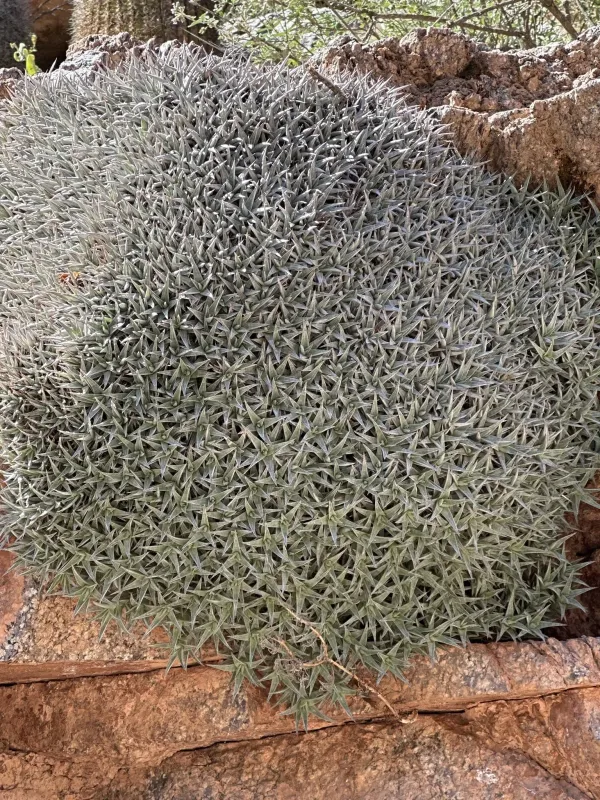
Description
Growing requirements
Deuterocohnia lorentziana is a perennial plant belonging to the Bromeliad family (Bromeliaceae). It is native to the rocky landscapes of Argentina, where it thrives in high-altitude environments characterized by intense solar radiation and periodic water scarcity.
Botanically, the plant forms dense, cushion-like colonies composed of stiff, narrow leaves arranged in rosettes. These leaves are covered with fine scales, an evolutionary adaptation that facilitates moisture retention and provides protection against the harsh sun.
To successfully cultivate this species, it is essential to provide bright, direct sunlight or at least very high light intensity. Without sufficient light, the plant loses its compact, cushion-forming structure, leading to elongated and etiolated leaf growth.
The soil requirements are strict: the medium must be extremely well-draining. A substrate consisting of gravel, coarse sand, and a minimal amount of organic material is recommended to ensure the roots do not remain damp, which would lead to rapid decay.
Deuterocohnia lorentziana is primarily utilized as an ornamental plant in xeriscaping and specialist succulent collections. Its ability to form large, structured mats makes it an excellent candidate for rock gardens and arid-themed landscapes where minimal water usage is desired.
Main diseases and pests
The primary threat to the health of this culture is root rot, induced by waterlogging or high humidity around the root ball. Consistent moisture in the leaf axils or soil medium will quickly compromise the plant's structural integrity.
Pests that frequently affect the plant include mealybugs and spider mites, which thrive in dry conditions. Regular inspections of the rosettes are necessary, as these pests tend to hide deep within the foliage where standard surface treatments may be ineffective.