
Deuterocohnia brevifolia
Deuterocohnia brevifolia
Description
Growing requirements
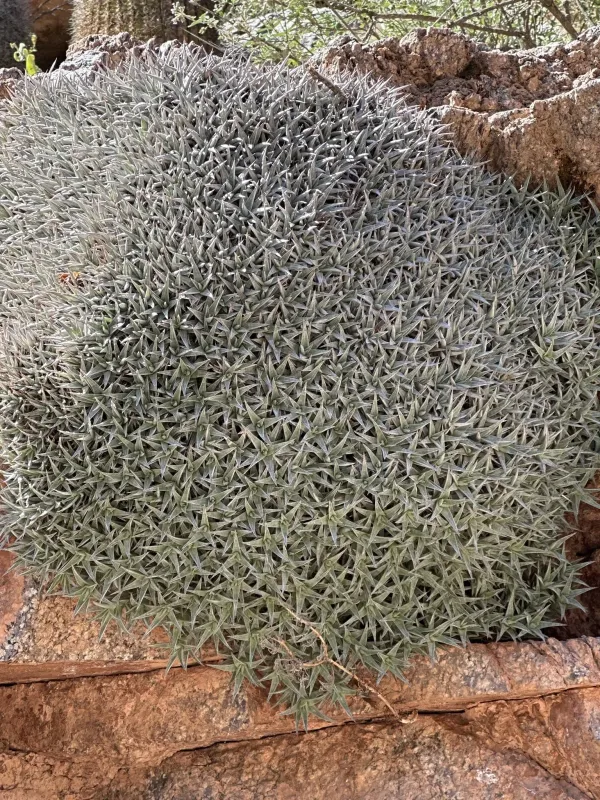
Deuterocohnia brevifolia is a remarkable perennial succulent belonging to the Bromeliaceae family. It is distinct for its cushion-forming growth habit, creating dense, mound-like colonies that can cover extensive areas on rocky outcrops in its native habitat.
The plant originates from the arid, high-altitude regions of South America, specifically in parts of Argentina and Bolivia. It has adapted to survive in environments characterized by harsh solar radiation, significant diurnal temperature fluctuations, and minimal precipitation.
Botanically, the plant consists of numerous tiny, compact rosettes. Its leaves are thick, succulent, and covered with trichomes, which help the plant reflect excess light and efficiently absorb moisture from the air, a common trait among many bromeliads.
Regarding agricultural and horticultural requirements, it demands full sun exposure and a highly porous, well-draining substrate. Because it naturally grows on rocks, it thrives in a mixture containing pumice, gravel, and minimal organic matter to prevent root rot.
In landscape use, this species is highly valued for xeriscaping and rock gardens. It serves as an excellent ground cover in suitable climates, providing year-round texture and structural interest that few other plants can offer in extreme, dry conditions.
Main diseases and pests
The primary threat to Deuterocohnia brevifolia is poor drainage and excess humidity. When the plant is subjected to stagnant water, especially in the core of its rosettes, it becomes highly susceptible to bacterial and fungal rot, which can destroy a colony quickly.
Insect pests, particularly mealybugs, can hide within the dense leaf clusters, making them difficult to detect and treat. Maintaining high air circulation and strictly avoiding overwatering are the most effective strategies for preventing infestations and disease outbreaks.