
Cistanche violacea
Cistanche violacea
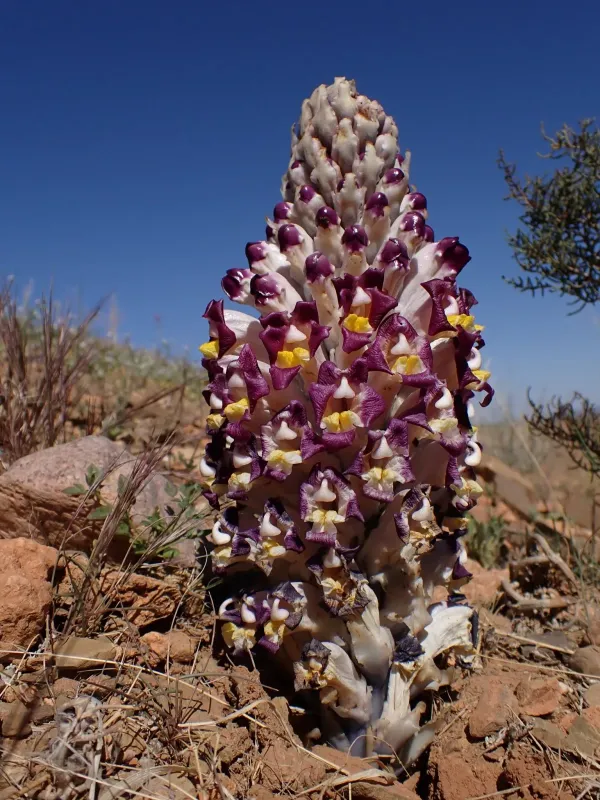
Description
Sowing dates
Cistanche violacea is an obligate parasite, meaning its sowing timeline is strictly dependent on the growth cycle of its host plant, typically species from the Chenopodiaceae family. The optimal time for inoculating seeds into the soil is during the host's active root growth phase, which usually occurs in early spring.
In natural habitats, reproduction relies on wind-dispersed seeds that remain viable in the soil for extended periods. In artificial cultivation, seeds are sown directly into the root zone of selected host shrubs to ensure the necessary physical contact for germination and haustorium formation.
Maintaining soil moisture during the germination window is critical, as the seeds require a stable environment to successfully attach to the host's root system. Early autumn sowing is also practiced in regions with mild winters, allowing the seeds to undergo natural stratification.
The technology requires precise spacing between infestation sites to avoid exhausting the host plant. Agronomists recommend placing seeds at a depth of 10 to 20 centimeters, targeting areas with the highest density of the host's feeder roots.
Monitoring the germination process should be conducted two to three weeks after sowing, provided weather conditions are favorable. It is essential to avoid over-irrigation during this stage to prevent the rotting of the seed material.
Growing requirements
Cistanche violacea is a root parasite of the Orobanchaceae family that requires highly specific ecological conditions. It depends entirely on the host plant for water, minerals, and organic nutrients throughout its entire life cycle.
This crop thrives in arid and semi-arid climates with high solar radiation. Sandy or loamy soils with low organic content are ideal, as they provide the excellent drainage and aeration required by this desert plant.
Temperature is a key factor; while the species is exceptionally heat-tolerant, it is highly sensitive to soil waterlogging, making proper drainage the most critical technical requirement for site selection.
The plant is well-adapted to saline soils where traditional crops fail. Moderate to high salinity levels in groundwater do not typically hinder its development, reflecting its evolutionary adaptation to harsh desert environments.
Agricultural management is focused on sustaining the health of the host plant, as the vigor of the Cistanche harvest is directly linked to the nutrient supply provided by the host shrub.
Yield
The yield of this crop is measured by the biomass of fresh, fleshy stems harvested during the flowering season. In commercial settings, productivity is directly correlated with the infection rate of the host plantation and the individual health of the hosts.
Average yields under managed conditions range from 500 to 1500 kilograms of raw weight per hectare. These figures can fluctuate significantly depending on the species of the host plant and the age of the infestation.
Quality is determined by the concentration of phenylethanoid glycosides, the primary compounds sought by the pharmaceutical industry. High thermal accumulation during the maturation phase helps maximize the concentration of these bioactive ingredients.
Methods to optimize the host plant density are used to boost overall biomass output. However, it is vital to balance this to prevent excessive parasitism, which could lead to the premature death of the host plant.
Harvesting is a labor-intensive manual process. However, the high market value of the dried product makes the cultivation of Cistanche violacea a highly profitable niche for specialized agricultural enterprises.
Main diseases and pests
Cistanche violacea faces minimal threat from traditional agricultural diseases, as it remains largely subterranean or protected by the host plant's tissues throughout its growth cycle.
The greatest risks come from soil-borne nematodes and fungal pathogens that attack the host's roots, leading to the indirect loss of the parasite. Pesticide use must be strictly minimized to protect the health of the donor plant.
Pests such as the larvae of certain flies or beetles may damage the emerging stems. Biological control methods, including the use of specific natural predators, are preferred over chemical interventions.
Overgrazing by livestock is a significant threat, as the stems are succulent and highly attractive to animals. Installing temporary fences or protective barriers is an essential component of professional field management.
Soil contamination by herbicides intended for other weeds is a critical threat that can result in total crop failure due to the parasite's extreme sensitivity to systemic chemical agents.
Harvesting
Harvesting takes place in spring during the peak flowering phase, when the stems are most concentrated with medicinal compounds. This timing ensures the highest biological and economic value of the raw material.
The stems are carefully extracted from the soil, taking great care not to damage the underlying root network of the host. Post-extraction, the stems are cleaned of sand and outer scales to prepare them for primary processing.
Processing involves drying in natural conditions or using temperature-controlled industrial dryers. Precise drying protocols are essential to preserve the glycoside content and prevent the growth of storage molds.
Once dried, the raw material becomes hardened and turns dark in color, making it suitable for long-term storage and transportation. Airtight packaging is mandatory to prevent moisture absorption during storage.
The final sorted and graded product is supplied to pharmaceutical processing facilities, where it undergoes extraction to isolate the active therapeutic substances.