
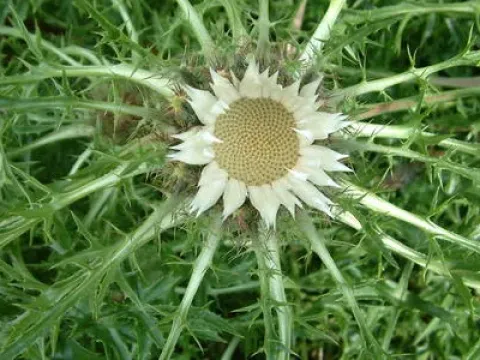
Carlina
Carlina L.
The sowing of Carlina species, most notably Carlina acaulis, is typically conducted in late autumn or early spring. The seeds require a period of stratification to break dormancy, making autumn sowing a preferred method in temperate climate zones.
What the section contains

Carlina
When spring sowing is planned, seeds must undergo cold stratification in a refrigerator at temperatures between 2 and 5 degrees Celsius for at least 40–60 days. This process ensures a more uniform germination rate across the field.
Seeds should be planted at a shallow depth of approximately 1 to 1.5 centimeters. Because the seeds are relatively small, deep planting can significantly hinder the emergence of seedlings and reduce the overall plant population density.
In commercial cultivation, row spacing should be maintained at about 40 to 50 centimeters. This provides sufficient space for the plant's characteristic wide, rosette-shaped foliage to develop during its initial growth phase.
Given the slow initial development of Carlina, intensive weed management during the first few months is critical. Keeping the rows free from invasive weeds ensures that young plants receive adequate nutrients and light for robust root establishment.
Carlina is a genus within the Asteraceae family that thrives in open, sun-drenched environments. As a light-loving plant, it requires full sun exposure to maintain vigorous health and maximize the production of medicinal compounds in the roots.
The ideal soil for this crop is well-drained, calcareous, and lean. Carlina is highly sensitive to waterlogged conditions, making adequate soil drainage a non-negotiable requirement for sustainable farm production.
The plant is naturally adapted to xeric conditions, meaning it is quite drought-tolerant once established. Its deep taproot allows it to access moisture from deeper soil layers, even during long, dry periods in the summer season.
Soil pH should ideally be neutral or slightly alkaline. In areas where the soil is naturally acidic, applying lime is a standard agricultural practice to adjust the chemical balance, thereby optimizing the plant's nutrient uptake.
Carlina exhibits excellent frost resistance and can easily survive harsh winters in open fields without protective cover. Its hardiness is a result of its evolutionary adaptation to the mountainous meadow climates of Europe.
The yield of Carlina is measured by the biomass of dried roots, which serve as the primary herbal product. The plants typically require two to three years of growth before they accumulate enough active substances to be harvested for commercial use.
Maintaining an optimal planting density of approximately 6 to 8 plants per square meter is essential for achieving a balanced yield. This spacing prevents overcrowding while ensuring enough biomass is generated per unit of area.
The roots are highly valued for their content of inulin, essential oils, and bitter resins. These components make Carlina a staple ingredient in various herbal teas, digestive supplements, and specialized pharmaceutical products.
Proper harvest yields depend on the overall vitality of the plantation. Consistent attention to soil fertility and moisture management during the early stages of growth significantly enhances the final weight and quality of the collected roots.
Upon harvest, the roots must undergo careful cleaning and processing. The economic viability of the crop is directly tied to the concentration of active ingredients, which is preserved through meticulous post-harvest management.
The primary threat to Carlina crops is root rot, which is almost exclusively associated with improper water management or heavy, compacted soils. Ensuring optimal aeration of the soil is the best prophylactic measure against this issue.
Fungal infections, such as leaf spot, may arise if humidity levels remain excessively high for extended periods. Maintaining good air circulation between rows by avoiding overly dense planting helps mitigate the risk of such diseases.
Soil-borne pests like wireworms can cause damage to the taproots of young plants. Crop rotation and pre-planting soil tillage are recommended strategies to reduce pest pressure and improve the survival rate of the crop.
Slugs may pose a threat to the foliage, particularly during damp spring weather. While they are usually a minor concern, keeping the area around the plants clear of decaying organic matter helps reduce their presence.
Because Carlina is frequently grown for pharmaceutical applications, integrated pest management (IPM) is favored over synthetic chemicals. Biological controls and sustainable farming techniques are generally sufficient to manage threats.
The harvesting of Carlina roots takes place in the autumn, once the plant has finished its vegetative cycle and the above-ground parts begin to senesce. This timing ensures that the roots contain the highest concentration of active compounds.
Specialized harvesting equipment, such as root plows, is used to extract the taproots from the soil. Care must be taken to minimize breakage, as clean, intact roots command a higher market value.
After extraction, the roots are thoroughly cleaned using cold water to remove soil particles and debris. Any damaged sections are trimmed away to maintain the quality of the raw material before the drying phase.
Drying must be conducted in controlled conditions, using well-ventilated drying rooms with temperatures below 45 degrees Celsius. This prevents the loss of volatile oils and ensures the inulin content remains stable.
Once dried, the product is stored in moisture-proof containers in a cool, dark environment. This prevents moisture absorption and maintains the medicinal integrity of the roots for long-term supply chains.