
American bluehearts
Buchnera americana
Description
Growing requirements
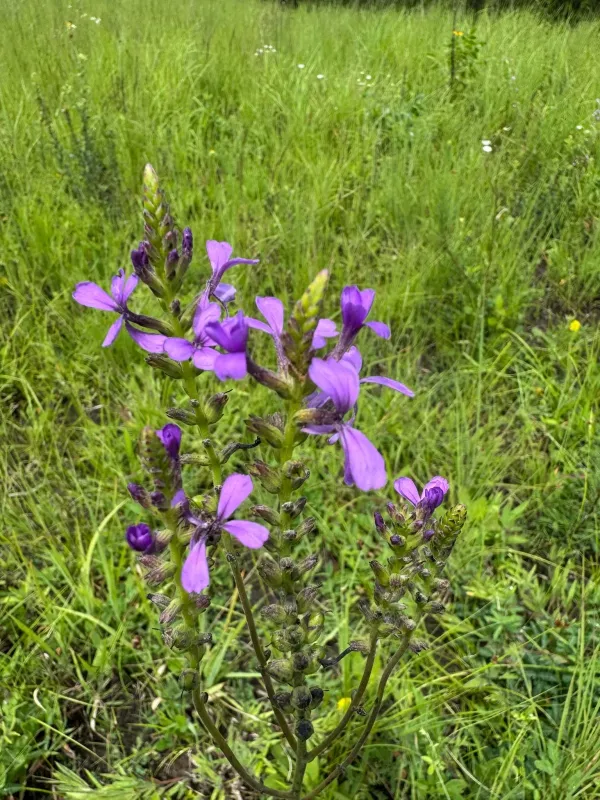
American bluehearts (Buchnera americana) is a herbaceous perennial plant belonging to the Orobanchaceae family. It is distinct for being a hemiparasite, meaning it derives some nutrients from host plants while still performing photosynthesis.
The plant is native to North America, typically found in dry prairies, open woodlands, and sandy meadows. It thrives in open, sunny locations where it can establish connections with the roots of suitable hosts.
Botanically, the plant is characterized by its root system that forms haustoria. These structures attach to the roots of grasses and other plants, allowing the bluehearts to supplement its nutrient intake in nutrient-poor environments.
The plant prefers well-drained, sandy, or rocky soils. It is highly sensitive to soil changes, particularly high nitrogen levels from fertilizers, which can disrupt its natural growth cycle and relationship with host plants.
As an agricultural crop, Buchnera americana is not cultivated. Its dependence on host plant associations makes it unsuitable for standard agricultural practices, and it is primarily observed in conservation and botanical studies.
Main diseases and pests
The primary threat to American bluehearts is habitat loss. The conversion of native prairies to agricultural fields significantly reduces the availability of host plants and suitable soil conditions.
Invasive plant species pose a severe threat by outcompeting bluehearts for space, sunlight, and host accessibility, which often leads to the decline of local populations.
Like many plants in the Orobanchaceae family, they are susceptible to various soil-borne pathogens and root rots if the moisture levels become excessively high for long periods.
The use of broad-spectrum herbicides in adjacent areas poses a significant risk to the plant, as it has little tolerance for synthetic chemicals commonly used in conventional farming.
Due to its status as a non-commercial, wild-growing plant, there is no standardized pest management protocol or agricultural strategy developed to protect this species in a cultivated setting.