
Baptisia cinerea
Baptisia cinerea (Raf.) Fernald & B. G. Schub.
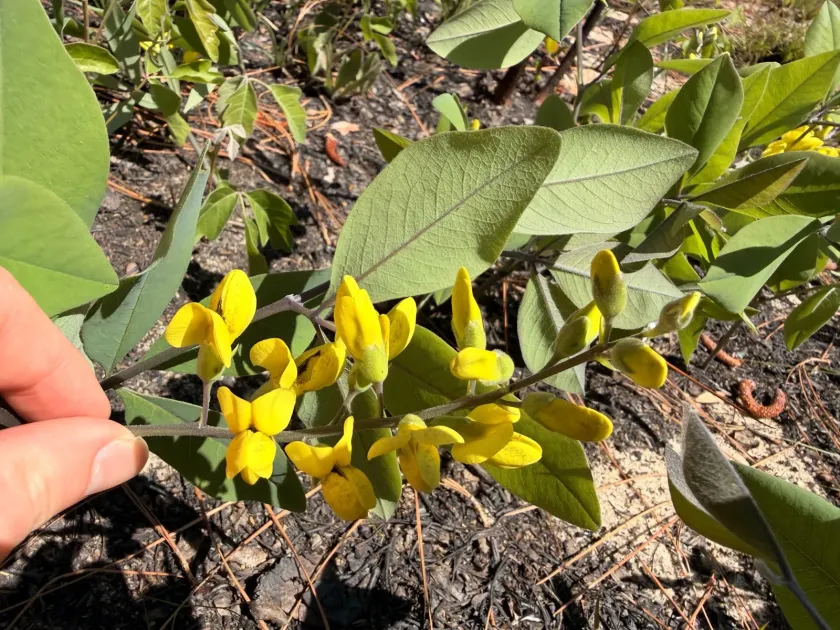
Description
Sowing dates
Seeds of Baptisia cinerea are best sown in late autumn to experience natural stratification, which is essential for improving overall germination rates.
For spring sowing, seeds require mechanical scarification of the tough seed coat followed by soaking in warm water to stimulate the internal embryo growth.
The ideal planting depth is approximately 1 to 2 centimeters, providing enough soil contact to stabilize the seedling while allowing it to reach the surface.
Sowing should be carried out in well-drained, sandy soils to prevent waterlogging, which is a major cause of seed failure in early stages of development.
Spacing should be managed to allow at least 60–80 centimeters between plants to accommodate the long-term growth of the vigorous root system and crown.
Growing requirements
Baptisia cinerea is a perennial herb belonging to the Fabaceae family, adapted to open, sunny environments with well-drained, nutrient-poor soil conditions.
The species thrives in sandy or rocky substrates where its deep taproot can penetrate deeply to access moisture, making it highly drought-tolerant once established.
Soil pH should range from slightly acidic to neutral to ensure optimal nitrogen fixation by symbiotic bacteria housed within the root nodules.
The plant requires full sun exposure throughout its vegetative cycle; any significant shade will reduce flower density and weaken the plant's overall health.
It is a low-maintenance crop that does not require heavy fertilization, as it is naturally evolved to survive in resource-limited ecological niches.
Main diseases and pests
Fungal diseases are the primary concern, particularly root rot, which typically develops if the soil remains excessively wet or lacks proper aeration.
Powdery mildew can affect the foliage during periods of high humidity and poor air circulation, reducing the plant's photosynthetic efficiency over time.
Insects like the weevil family can target the root nodules, potentially hindering the plant's ability to fix nitrogen and survive in nutrient-poor soils.
Leaf-chewing larvae can cause periodic defoliation, though healthy established plants are usually robust enough to recover without chemical intervention.
Effective management includes maintaining proper distance between plants and avoiding over-irrigation, which helps mitigate most standard soil-borne threats.