
Anthorrhiza recurvispina
Anthorrhiza recurvispina
Description
Growing requirements
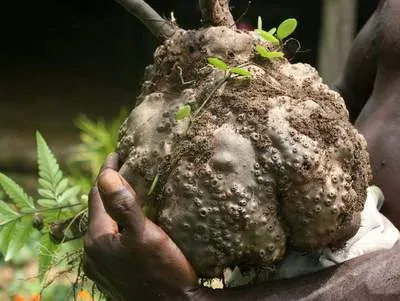
Anthorrhiza recurvispina is a specialized plant species belonging to the Rubiaceae family. Known for its complex, swollen caudex, it functions as a myrmecophyte, providing a sheltered habitat for ants in exchange for nutrients and protection.
Originating from the tropical rainforests of New Guinea, this species thrives in humid, shaded environments. It typically grows as an epiphyte on host trees, attaching itself to branches where it can access diffuse light and moisture.
The climate requirements for this plant include constant warmth and high ambient humidity levels. It cannot tolerate temperatures below 18 degrees Celsius or prolonged periods of drought, which would disrupt its biological functions.
For cultivation, one must replicate its natural epiphytic habitat. A highly porous, chunky substrate consisting of tree bark, charcoal, and perlite is essential to ensure that the roots and the internal cavities of the caudex receive adequate airflow.
Irrigation should be performed with soft or distilled water. The substrate should remain moist but never waterlogged. Any excess water must be allowed to drain away immediately to prevent the suffocation of the specialized root system.
Main diseases and pests
The primary threats to Anthorrhiza recurvispina involve poor environmental control. High humidity without adequate ventilation creates a breeding ground for fungal pathogens that can cause rapid decay of the delicate caudex tissue.
Common pests include mealybugs and scale insects. These pests often hide in the crevices of the caudex or the undersides of the leaves, making them difficult to detect until the plant's health has significantly declined.
Over-fertilization can be detrimental to this species. As an epiphyte, it is adapted to low-nutrient environments; therefore, high concentrations of synthetic fertilizers can lead to chemical burns on the root systems.
Root rot is the most common cause of plant loss. This is almost always triggered by the breakdown of the potting medium or the use of heavy, water-retaining soils that do not allow for the necessary gas exchange at the root level.
Finally, environmental instability, such as sudden changes in temperature or prolonged exposure to direct sunlight, can stress the plant, leading to leaf drop and a weakened immune system, making it more susceptible to secondary infestations.