
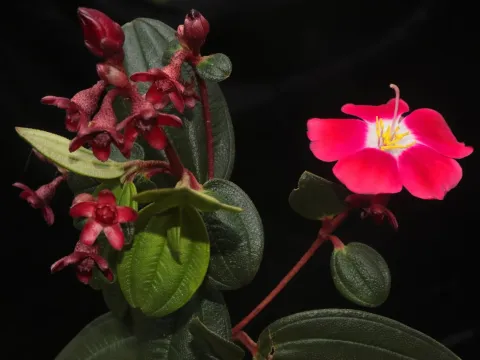
Andesanthus
Andesanthus
Andesanthus seeds are sown in early spring when the soil temperature warms up to +10…+12 degrees Celsius. Since the culture originates from high-altitude regions, it possesses a specific seed dormancy period that requires preliminary stratification.
What the section contains

Andesanthus
To obtain high-quality seedlings, it is recommended to sow in protected ground 6–8 weeks before the intended planting in a permanent location. This allows the plant to strengthen and form a developed root system for adaptation to open air.
The planting depth of seeds should be minimal, no more than 0.5–1 cm, as the seeds are light-sensitive and require oxygen for successful germination. Watering after sowing should be moderate to avoid washing out or rotting of the planting material.
The optimal planting pattern assumes a distance between plants of at least 30–40 cm, as the adult Andesanthus forms a compact but dense leaf rosette. Crowding crops is extremely undesirable due to the risk of fungal disease development.
In its natural habitat, the plant's natural regeneration occurs through seeds at the beginning of the rainy season, which determines the environmental preferences of the plant when introduced into cultivation.
Andesanthus is a typical representative of Andean flora, so it is extremely demanding of lighting. For full growth, the plant needs bright direct sunlight throughout the entire daylight hours.
The culture imposes strict requirements on soil conditions: the substrate must be as light as possible, with a high proportion of aeration, stony or sandy. Moisture stagnation in the root zone is fatal for this species.
The optimal soil acidity level for the successful development of Andesanthus is in the range of weakly acidic or neutral reaction. On heavy clay soils, the plant practically does not survive without a significant improvement of the drainage layer.
The temperature regime should simulate a cool highland, where daytime temperatures do not exceed +22 degrees and nighttime temperatures drop significantly. The culture tolerates sharp temperature drops well, which is an adaptive feature.
Watering should be strictly dosed, preferably by drip irrigation, to avoid wetting the root collar, which is prone to rotting under excessive humidity of air and soil.
The economic value of Andesanthus primarily lies in its ornamental potential, as well as the possibility of obtaining seed material for specialized botanical collections.
The indicators of biological biomass yield are low, as the plant's main energy vector is directed towards the formation of reproductive organs in specific high-altitude climatic conditions.
When cultivated on an industrial scale (for example, for pharmaceutical or landscape design needs), the yield of green mass is about 1.5–2 tons per hectare, subject to strict adherence to agrotechnological regulations.
Maximum marketable output is achieved in the second year of vegetation, when the plant is fully adapted to the conditions of the site and passes through the cycle of spring green mass growth.
Seed harvesting is carried out selectively, as the inflorescences turn brown, which allows for the most high-quality material with high germination energy for subsequent reproduction cycles.
The main enemy of Andesanthus is fungal pathogens, such as root rot and fusarium, which arise as a result of waterlogging or violation of crop rotation rules on the plot.
Among pests, spider mites and thrips pose the greatest danger; in dry air, they are capable of damaging the delicate leaf blade of the plant in a short time.
Powdery mildew can infect crops with insufficient air circulation and high humidity, which requires immediate treatment with copper-based fungicides or biological agents.
Damage to the root system by larvae of soil insects can also become a gateway for secondary infections, so pre-sowing soil treatment is a mandatory element of care.
- Regular phytosanitary monitoring of crop status.
- Use of gravel mulching to prevent leaf contact with the soil.
- Strict adherence to the watering regime to reduce humidity in the root zone.
Harvesting the above-ground part of Andesanthus is carried out during the full flowering phase if the goal is to obtain plant raw materials for decorative purposes or medical research.
Cutting should be done with a sharp tool in the morning hours when the plant is saturated with moisture, which ensures a better commercial look of the products and prolongs their shelf life after collection.
If Andesanthus is grown for seeds, harvesting is carried out in two stages, sequentially cutting flower stalks as they ripen to avoid self-seeding and the loss of the highest quality seeds.
After collection, the plant mass must undergo a process of rapid drying in a shaded, well-ventilated place to preserve the natural color and structure of the leaves or flowers.
Long-term storage of collected material requires humidity control, as the hygroscopicity of Andesanthus tissues predisposes them to rapid spoilage if ventilation regimes are violated.