
Acacia ligulata
Acacia ligulata
Description
Sowing dates
The sowing of Acacia ligulata, commonly known as Umbrella Bush, is best timed for the start of the spring season when soil temperatures remain consistently warm, promoting rapid germination.
The seeds possess a hard, impermeable seed coat, which necessitates pre-sowing treatments such as mechanical scarification or soaking in hot water to break dormancy and ensure uniform emergence.
Seeds should be planted at a shallow depth of 1–2 cm in well-drained, sandy soils. Ensuring the planting medium is not overly compacted is essential for the initial establishment of the root system.
When cultivated for large-scale land stabilization, direct seeding is common, whereas small-scale establishment often utilizes peat containers to allow for successful transplantation without root shock.
Providing adequate moisture during the first few weeks after germination is crucial, even for such a hardy species, to ensure the seedling establishes a deep taproot capable of accessing groundwater.
Growing requirements
Acacia ligulata is a legume species native to the arid and semi-arid regions of Australia, exhibiting extreme resilience to drought, high heat, and poor soil fertility.
This shrub requires full sun exposure and is highly intolerant of shade. It thrives in various soil types, particularly sandy, saline, or alkaline substrates that are unsuitable for standard crops.
The most critical requirement for long-term health is excellent drainage. The species is highly susceptible to root decay if subjected to waterlogging or heavy, clay-based soil conditions.
It is well-adapted to regions experiencing erratic rainfall, as its metabolic processes are finely tuned to survive long dormant periods between sparse precipitation events.
As a nitrogen-fixing plant, it improves soil quality over time, making it an excellent candidate for ecological restoration projects and windbreak installation in desertified areas.
Yield
While not harvested as a traditional cash crop, Acacia ligulata serves as an essential source of fodder in arid agricultural zones where forage availability is extremely limited.
The foliage provides a protein-rich supplement for livestock, especially when other perennial grasses are dormant or have been depleted due to prolonged drought conditions.
Biomass productivity is directly influenced by the availability of soil moisture, yet the species remains one of the most reliable sources of green feed in harsh environments.
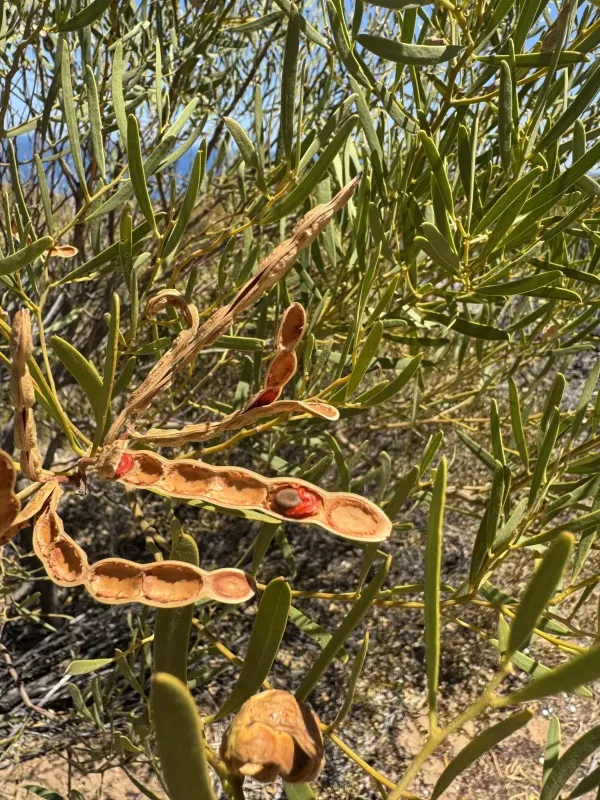
The seeds produced in pods offer potential for supplemental protein feed, although harvesting efficiency remains a challenge due to the shrub's architectural structure.
Its primary economic yield is indirect, manifesting through increased soil stability, reduced erosion rates, and the long-term restoration of marginal farmland productivity.
Main diseases and pests
Acacia ligulata is naturally robust and rarely suffers from severe disease outbreaks under conditions that match its native habitat requirements.
Root rot, primarily caused by Phytophthora species, is the most significant threat if the soil remains waterlogged or if drainage systems fail during unusually rainy periods.
Insect pests such as wood-boring beetles or leaf-eating caterpillars can impact plant vigor, particularly in overcrowded stands or under stressed conditions.
Rodents and rabbits pose a significant threat to young, developing seedlings, often requiring physical protection or exclusion fencing during the first stages of growth.
Integrated pest management in this species focuses on maintaining proper air circulation and avoiding the application of heavy chemical fertilizers that could disrupt its natural symbiotic relationships.