

Description
How to tell it apart
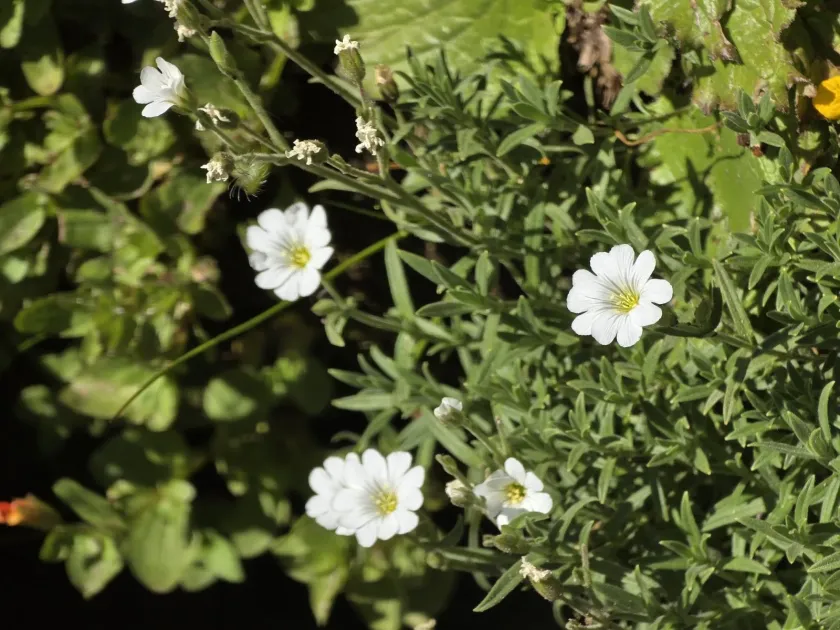
Field mouse-ear (Cerastium arvense) is a perennial weed belonging to the Caryophyllaceae family. It is characterized by its ability to form extensive mats or patches due to its spreading underground rhizomes.
The stems of the plant are generally 15–30 cm tall, sometimes hairy or glandular, and can be either erect or sprawling. Its leaves are opposite, linear to lanceolate in shape, and typically sessile.
The flowers are distinct with five white petals, each deeply notched, creating a star-like appearance. It typically blooms from late spring to summer, producing numerous capsules filled with small seeds.
The root system consists of creeping, branching rhizomes that allow it to propagate vegetatively. This makes the weed particularly resilient to shallow tillage methods that may fragment the roots rather than eliminate them.
The seeds are small, reddish-brown, and rough-surfaced, which helps them survive in the soil seed bank for extended periods, waiting for favorable conditions to germinate.
Where it grows
Field mouse-ear is widely distributed across temperate regions. It thrives in well-lit areas, including meadows, field margins, roadsides, and open rocky or sandy terrains.
In agricultural settings, it is a significant nuisance in cereal crops, perennial grasslands, and row crops. It tends to establish itself quickly in fields that have been left fallow or poorly managed.
The plant shows high ecological adaptability, preferring light, well-drained soils but capable of surviving in various environments. Its preference for open areas allows it to colonize field edges and then spread into the crops.
In fields with high moisture and high light availability, the weed can form dense, choking mats that compete aggressively with the sown crop. It is a persistent weed that returns year after year if not managed.
The movement of soil and agricultural machinery often disperses root fragments across the field, leading to new patches of the weed forming in otherwise clean areas of the plot.
Harm it causes
The primary damage caused by field mouse-ear is its competition for vital resources like water, nutrients, and sunlight. It extracts nitrogen from the soil, which slows the growth of crops like wheat or barley.
By forming dense cover, the weed reduces the crop density, which directly impacts the potential harvest. In the early stages of crop development, the shading effect can cause significant stunting.
The presence of this weed serves as a harbor for various plant diseases and pests. It can act as an alternate host, allowing diseases to persist in the field and infect the crops during the growing season.
Harvester contamination is another concern; the seeds of the field mouse-ear are difficult to separate from cereal grains, often resulting in lower quality yields and increased processing costs.
Ultimately, the infestation of field mouse-ear can lead to significant economic losses, forcing farmers to increase their expenditure on herbicides and additional field operations to maintain clean crops.
How to control
Effective management begins with deep plowing or primary tillage that turns the soil over, as this helps to bury the rhizomes and inhibits the plant’s capacity for vegetative regrowth.
Mechanical control, such as inter-row cultivation in row crops, is highly effective for breaking up the weed patches. Competitive cropping, which involves high planting densities, can also shade out the weed.
Chemical control is often required, particularly using systemic herbicides. These should be applied during the plant's active growth phase, generally before it begins to flower, to ensure maximum chemical translocation to the roots.
- Use of sulfonylurea-based herbicides for post-emergence control.
- Implementation of a balanced crop rotation system to disrupt weed cycles.
- Post-harvest cultivation to expose and desiccate rhizomes.
- Strict monitoring of field edges to prevent encroachment into crop fields.
In cases of severe infestation, a non-selective herbicide like glyphosate can be used post-harvest to clear the field of perennial weeds, though this must be managed in accordance with local environmental regulations.
Content graph
Connections · Field mouse-ear
Most often together:
Marketplace
Products · 2

Stefuron, WG (tribenuron-methyl, 750 g/kg)
ДДЕ Фарм АГ, Тризен, Ліхтенштейн
Herbicides
0
0
·
45
6 offers
27.42 €per 1 l
Buy
Biology
Taxonomy
- Latin name
- Cerastium arvense
- Family
- Гвоздичные
- EPPO code
- CERAR