
Trianthema portulacastrum
Trianthema portulacastrum
Description
How to tell it apart
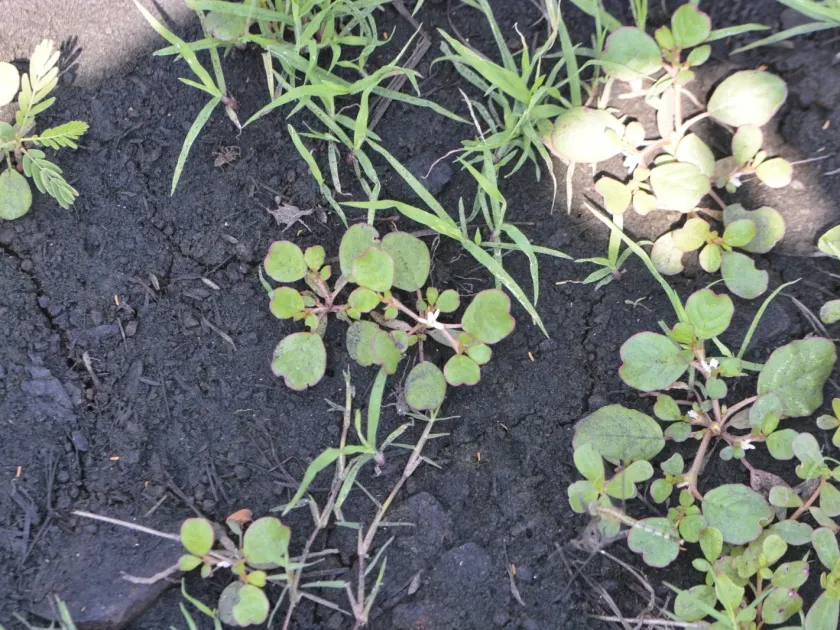
Trianthema portulacastrum, commonly known as horse purslane, is a member of the Molluginaceae family. It is a succulent annual herb characterized by prostrate or ascending stems that can spread up to 70 cm in length.
The leaves are opposite, often unequal in size, fleshy, and obovate or spatulate in shape. The plant has a smooth texture, often displaying reddish margins, which gives it a distinct appearance resembling common purslane.
Flowers are solitary, axillary, and sessile, typically possessing white or pinkish perianth segments. The plant is known for its ability to produce a massive number of seeds during a single growing season.
The fruit is a circumscissile capsule containing several small, blackish, rugose seeds. These seeds are capable of remaining dormant in the soil for extended periods, contributing to the persistence of the weed.
The root system consists of a deep taproot that allows the plant to efficiently extract water and nutrients, making it highly resilient to competition and variable environmental conditions.
Where it grows
Horse purslane is widely distributed across tropical and subtropical regions globally. It thrives in high-temperature environments and is particularly invasive in areas with disturbed or cultivated soils.
It is frequently reported as a major weed in crops such as cotton, soybeans, maize, and rice. The plant shows a preference for well-drained but moist soils and is highly prolific in irrigated agricultural fields.
The species is also a common component of ruderal vegetation, appearing along roadsides, irrigation canals, and waste areas where it can readily colonize exposed surfaces.
In mechanized farming systems, it aggressively exploits the gaps between crop rows, rapidly developing a dense canopy that shades out smaller, slower-growing crops.
The plant's adaptability to various soil types, ranging from sandy to loamy, ensures its success across diverse agricultural landscapes, from field crops to intensive horticulture.
Harm it causes
The primary harm caused by Trianthema portulacastrum is severe resource competition. By utilizing soil moisture and nutrients effectively, it significantly reduces the development and yield potential of cash crops.
It acts as an alternative host for various pests and pathogens, including viruses that specifically target crops like beans and cotton. This creates an ongoing disease pressure in the field.
The succulent nature of the plant and its rapid growth create a dense carpet that prevents the germination and establishment of crop seedlings in early growth stages.
During harvest, high infestations of the weed can interfere with mechanical harvesters, causing equipment clogging and reducing the efficiency of the entire operation.
Economic losses are often substantial, as the weed can drastically reduce yield and necessitate increased expenditure on labor or agrochemicals to maintain field hygiene.
How to control
Integrated weed management is essential for controlling horse purslane. Because of its prolific seed production, the goal is to eliminate the weed before the onset of flowering and seed maturation.
Mechanical control, including manual weeding, hoeing, and row cultivation, is highly effective if performed early in the season before the plant establishes its deep taproot system.
Chemical control involves the application of pre-emergence or post-emergence herbicides registered for use in the target crop, ensuring the application timing aligns with the weed's vulnerability.
- Application of residual soil herbicides pre-planting.
- Post-emergence spraying when the weed is in the seedling stage.
- Maintenance of irrigation ditches to prevent seed dispersal via water.
Cultural practices, such as maintaining a dense crop canopy through proper spacing and choosing competitive varieties, can also suppress the growth of this weed by limiting its access to sunlight.
Taxonomy
- Latin name
- Trianthema portulacastrum
- Family
- Аизовые
- EPPO code
- TRTPO