
Titanopsis calcarea
Titanopsis calcarea
Description
How to tell it apart
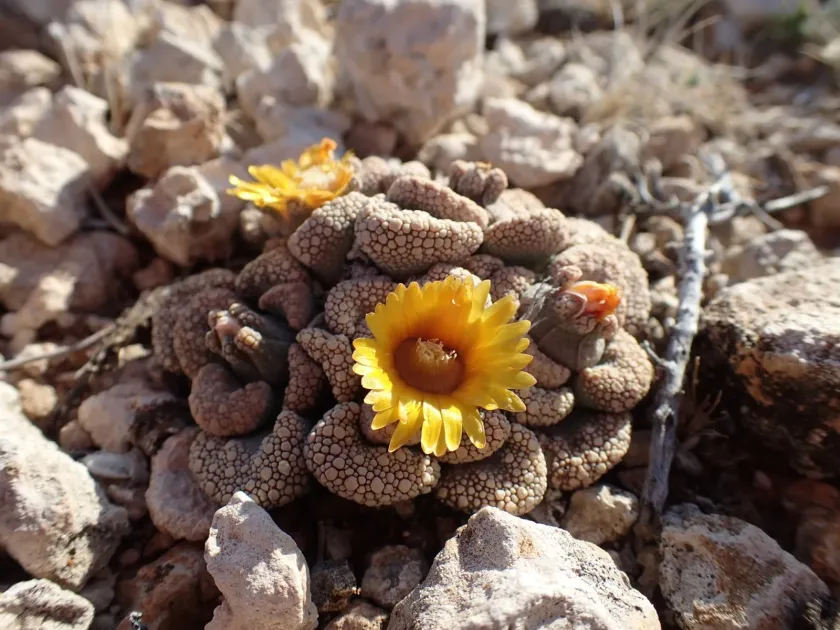
Titanopsis calcarea is a compact succulent of the Aizoaceae family, forming low rosettes of fleshy leaves. The leaf surface is covered with characteristic limestone-like tubercles, giving the plant a camouflage appearance similar to rocks.
Biologically, it is a low-growing perennial succulent adapted to extreme arid conditions. Its root system is shallow but tenacious, allowing the plant to anchor effectively in rocky, mineral-rich substrates.
The plant exhibits colors ranging from gray-green to reddish-brown, which helps it blend into natural stony environments. The leaves are truncate with a rough texture, designed to absorb moisture efficiently from atmospheric condensation.
Flowering occurs in autumn, producing bright yellow daisy-like flowers. The seeds are extremely small, easily dispersed by wind, and remain viable for long periods in dry environments.
In an agronomic context, this species is rarely a concern for field crops, but it can aggressively colonize specialized nurseries or greenhouses, suppressing the growth of more delicate ornamental species.
Where it grows
Titanopsis calcarea is primarily found in the arid regions of South Africa, particularly the Karoo, where limestone soils prevail. It thrives in locations with full sun and minimal competition from taller plants.
In managed landscapes, this species may become a weed in rock gardens, xeriscapes, or greenhouses where moisture and substrate balance are altered. It readily establishes itself in crevices between stones and paving.
The plant cannot tolerate waterlogging, which explains why it is seldom found in traditional cereal or vegetable fields. The primary risk is confined to specialized succulent collections and nursery production areas.
Its spread is limited by low moisture zones, as excess water leads to rapid root rot. It lacks the competitive vigor to overpower fast-growing annual weeds in fertile, moist soils.
While an essential part of its native ecosystem, in artificial cultivation, it may disrupt the development of neighboring plants by competing for limited space and light in confined containers.
Harm it causes
The harm caused by Titanopsis calcarea in an agronomic sense is extremely low. It does not possess allelopathic properties and is not a known vector for pests or pathogens affecting commercial crops.
The primary concern is the infestation of specialized succulent collections. Seeds can infiltrate substrates, and the plant's high survival rate allows it to displace more valuable or slower-growing species.
It can complicate the maintenance of ornamental areas by establishing itself in drainage layers. Manual removal is difficult as small leaf fragments can re-root if moisture levels are sufficient.
In mass-produced greenhouse environments, Titanopsis can block drainage systems or create excessive weight in mulch layers, hindering proper soil aeration for other plants.
This object is best classified as an undesirable plant for specific garden designs rather than a weed that threatens food security or agricultural production.
How to control
The primary control method is manual weeding, ensuring the complete removal of the root system. It is critical to leave no fragments, as the plant can reproduce vegetatively under favorable conditions.
To prevent seed dispersal, top-dressing the substrate with a layer of fine gravel is recommended. This inhibits seed germination and limits the contact of leaves with moist soil surfaces.
Chemical control is rarely utilized and only warranted in cases of severe infestation. Non-selective herbicides such as glyphosate can be used, but extreme care is necessary to avoid damaging valuable nearby plants.
Modifying irrigation regimes is a highly effective preventative measure. Because the plant is sensitive to overwatering, adjusting the humidity levels can naturally suppress the population.
Routine inspection of planting beds and the removal of juvenile rosettes at an early stage are the most cost-effective and environmentally friendly ways to manage this species.
Taxonomy
- Latin name
- Titanopsis calcarea
- Family
- Аизовые
- EPPO code
- TISCA