
New Zealand spinach
Tetragonia tetragonoides
Description
How to tell it apart
Tetragonia tetragonoides, commonly known as New Zealand spinach, belongs to the Aizoaceae family. It is a succulent, prostrate or decumbent annual plant characterized by thick, triangular-ovate leaves covered in small papillae.
The stems are fleshy, heavily branched, and can spread up to a meter in length. The leaves are typically bright green and have a distinct texture due to the bladder cells on their surface, a key feature for field identification.
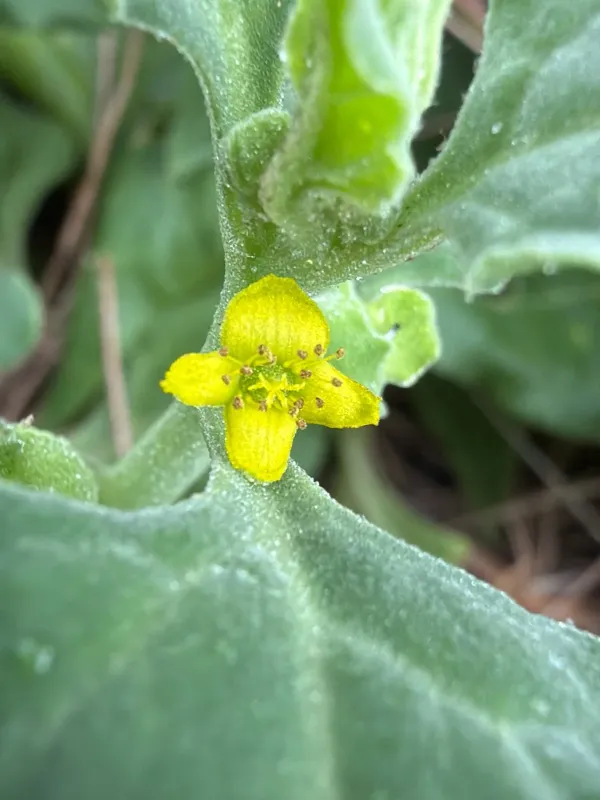
The flowers are small, yellow, and solitary, located in the leaf axils on short stalks. Lacking true petals, they rely on sepals for structural integrity and are efficient at self-pollination, ensuring high reproductive success.
The fruit is a woody capsule with prominent horn-like appendages. These structures are vital for identification and act as a mechanism for dispersal, as they easily attach to agricultural machinery or animals passing through the field.
The root system is robust and deep-seated, which confers significant drought resistance. This biological trait allows the weed to persist in competitive environments where resources like water are limited.
Where it grows
Native to coastal regions and sandy soils, this plant has adapted to agricultural landscapes. It is frequently found in vegetable gardens, orchards, and irrigated crop fields where soil conditions are favorable.
It thrives in loose, well-aerated soils and is often observed on field margins, fallow lands, and areas where organic waste accumulates. It is an opportunistic colonizer of disturbed soils.
Dispersal is primarily facilitated by human activity, including the movement of contaminated equipment and the application of unsterilized manure that contains dormant seeds.
Its ecological plasticity allows it to establish quickly in diverse climates. In irrigated agricultural systems, the plant can remain green and continue growing throughout the entire season, creating dense vegetative mats.
The plant prefers areas with minimal competition during its initial growth phase, but once established, it can easily expand into more densely planted fields by utilizing open spaces between crop rows.
Harm it causes
The primary harm caused by this weed is the intense competition for soil nutrients and water. Its rapid growth and spreading habit result in heavy shading of young crop seedlings, significantly impeding their development.
Tetragonia tetragonoides serves as a host for various pests and pathogens that affect commercial crops. This increases the overall infection pressure within the field, requiring more intensive phytosanitary management.
The succulent nature of the plant complicates the harvesting process. It clogs harvesting machinery, increases the moisture content of the harvested crop, and promotes post-harvest decay due to the introduction of excessive biomass.
Heavy infestations can lead to a significant decline in crop yields. The weed effectively sequesters soil nitrogen, creating a nutrient deficit that restricts the growth potential of the intended crop.
Beyond direct competition, the accumulation of salts in the plant tissues can alter the local soil chemistry within the rhizosphere, potentially impacting the health and nutrient uptake efficiency of nearby crops.
How to control
Agronomic control relies heavily on timely inter-row cultivation. Disturbing the soil before the weed reaches the flowering stage is crucial to prevent the production of the persistent, woody seed capsules.
Crop rotation with competitive, dense-canopy crops effectively suppresses the weed by limiting its access to sunlight. Integrating cover crops during fallow periods can further reduce the seed bank in the soil.
Chemical control involves the application of selective herbicides targeted at broad-leaved weeds. It is essential to apply these treatments early, as the plant becomes more resistant to chemicals once the woody capsules develop.
Pre-emergence herbicides are highly effective in blocking the germination of seeds. This approach is recommended for fields with a history of infestation to maintain a clean environment from the start of the season.
- Implement rigorous equipment sanitation protocols between fields
- Ensure high-purity seeds are used to prevent initial contamination
- Manual roguing in small-scale vegetable plots
- Use of mulching films to physically prevent seedling emergence
Taxonomy
- Latin name
- Tetragonia tetragonoides
- Family
- Аизовые
- EPPO code
- TEATE