
Small-flowered carpetweed
Kallstroemia parviflora
Description
How to tell it apart
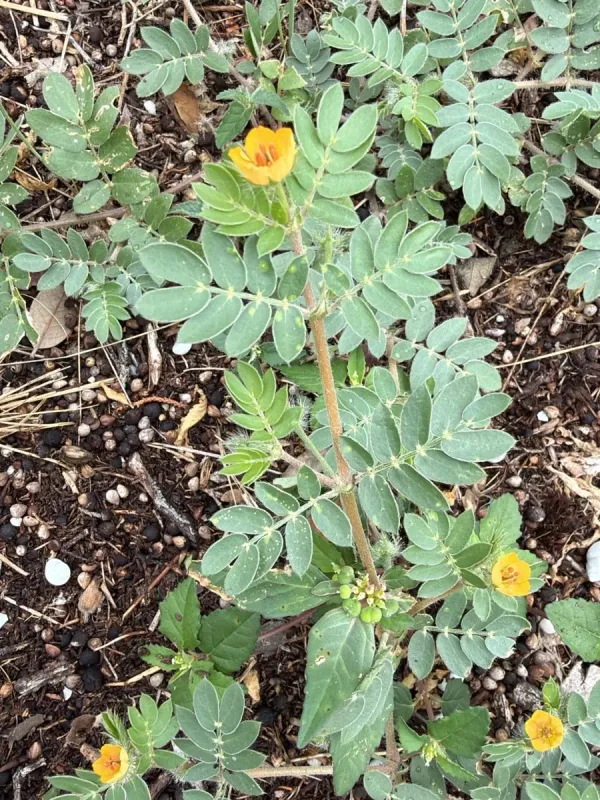
Small-flowered carpetweed (Kallstroemia parviflora) is a member of the Zygophyllaceae family, recognized for its low-growing, mat-forming habit.
The plant features branched stems that spread horizontally across the soil surface, effectively covering large areas.
Leaves are pinnately compound and opposite, providing a reliable diagnostic feature for identifying the plant in agricultural landscapes.
The flowers are small, yellow, and solitary, usually found in the leaf axils, contributing to the plant's rapid reproductive cycle.
Its fruit is a schizocarp that splits into segments at maturity, facilitating the dispersal of seeds across the field.
Where it grows
The species is primarily native to the Southwestern United States, where it thrives in arid and semi-arid environmental conditions.
It is commonly found in disturbed sites, roadsides, pastures, and uncultivated fields where competition from other vegetation is low.
In farming, it frequently invades row crops, especially in sandy or well-drained soils that heat up quickly during the growing season.
The plant demonstrates a high tolerance for drought, allowing it to survive in regions where other weeds might struggle due to water scarcity.
It prefers high-light environments and is often one of the first species to colonize exposed soil in open fields.
Harm it causes
Kallstroemia parviflora exerts significant pressure on crops by competing for limited soil moisture and available nutrients.
Its mat-forming structure shades out smaller crop seedlings, significantly reducing early-season growth and overall plant vigor.
By occupying space, the weed interferes with the development of crops, leading to potential yield losses in competitive agricultural scenarios.
The presence of this weed at harvest can contaminate the produce, reducing market value and complicating grain cleaning processes.
Due to its resilience, it can persist throughout the season, continuously draining resources that would otherwise support crop development.
How to control
Effective management begins with robust crop rotation strategies designed to disrupt the life cycle of this invasive species.
Deep plowing is recommended as a mechanical intervention to bury seeds too deep for successful germination in subsequent seasons.
Inter-row cultivation is highly effective for younger plants, preventing them from establishing the dense mats characteristic of mature weeds.
Chemical control involving selective herbicides must be applied according to regional regulations and the specific crop being protected.
Integrated Weed Management (IWM) practices, including sanitation of farm machinery, help prevent the spread of seeds between different fields.
Taxonomy
- Latin name
- Kallstroemia parviflora
- Family
- Парнолистниковые
- EPPO code
- KALPA