
Kallstroemia hirsutissima
Kallstroemia hirsutissima
Description
How to tell it apart
Kallstroemia hirsutissima, commonly known as hairy caltrop, is an annual herb belonging to the Zygophyllaceae family. It is characterized by its prostrate growth habit, forming dense mats across the soil surface.
The stems and foliage are covered with dense, stiff hairs, which gives the plant its distinct "hairy" appearance. Leaves are opposite, pinnately compound, and contribute to the plant's thick vegetative cover.
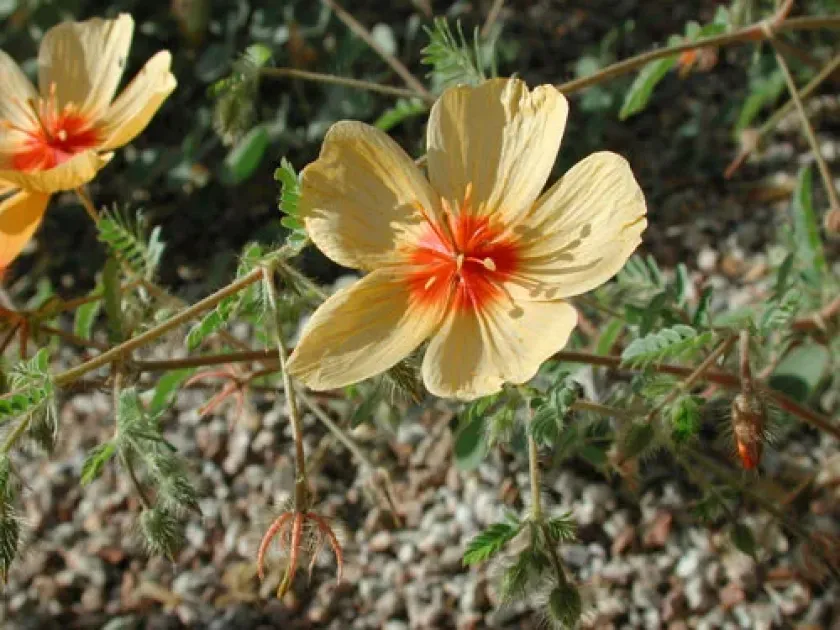
The flowers are typically yellow or orange, solitary, and grow in the leaf axils. They have five petals and are easily recognizable once the plant begins its flowering phase.
The fruit is a spiny, woody capsule that breaks into individual segments when mature. These segments often have sharp prickles, aiding in seed dispersal by adhering to animal fur or machinery.
Its deep taproot system allows the plant to persist in harsh, dry environments, making it a highly resilient and competitive weed in various agricultural settings.
Where it grows
This species thrives in open, sunny environments with sandy or disturbed soils. It is frequently found in pastures, roadsides, and areas with low-intensity land management.
In cultivated fields, it poses a significant threat to row crops such as corn, cotton, and sorghum, especially where the crop canopy is not dense enough to shade out competing vegetation.
It is well-adapted to arid and semi-arid climates, often dominating wasteland or abandoned fields where moisture is scarce and soil fertility is relatively low.
Seed dispersal is facilitated by wind, water runoff, and the movement of agricultural equipment, which often introduces the weed into new, previously clean areas.
It also colonizes irrigation ditch banks, allowing its seeds to be carried throughout the farm via irrigation water, leading to widespread infestation.
Harm it causes
The primary damage caused by Kallstroemia hirsutissima is its aggressive competition for limited soil moisture, which can severely stress crops during critical growth stages.
Its mat-forming nature suppresses the emergence and development of crop seedlings by physically covering the soil and competing for essential sunlight.
The presence of sharp, spiny fruit makes infested fields unsuitable for grazing livestock, as the burrs can cause significant injury to the mouths and digestive tracts of animals.
Harvesting efficiency is significantly reduced when this weed is present, as the tough stems can clog machinery and increase the moisture content of the harvested grain.
Repeated infestation leads to a massive seed bank in the soil, which necessitates long-term and costly weed management programs to restore crop productivity.
How to control
Successful management of hairy caltrop requires a multi-year strategy involving mechanical tillage and the strategic use of herbicides to prevent seed production.
Mechanical control is most effective when performed early in the season through regular inter-row cultivation that disturbs the root system before the plants flower.
- Deep plowing to bury seeds, preventing them from germinating.
- Crop rotation with dense-canopy crops to shade out weeds.
- Sanitation of equipment to prevent cross-contamination.
Chemical control options include pre-emergence and post-emergence herbicides. Choosing the right herbicide requires considering the growth stage of the crop and the specific environmental conditions.
Preventative measures, such as mowing field borders and managing ditch banks, are essential to stop the spread of seeds and ensure the long-term success of weed control efforts.
Taxonomy
- Latin name
- Kallstroemia hirsutissima
- Family
- Парнолистниковые
- EPPO code
- KALHI