
Kallstroemia californica
Kallstroemia californica
Description
How to tell it apart
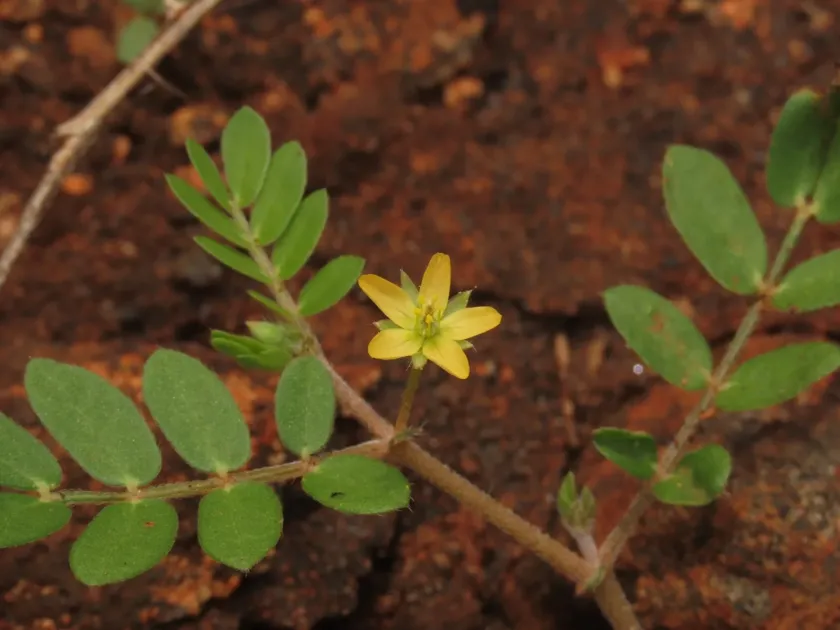
Kallstroemia californica is an annual herbaceous plant belonging to the Zygophyllaceae family. It is characterized by prostrate, spreading stems that form dense mats over the soil surface.
The leaves are opposite and pinnately compound, typically featuring three to five pairs of leaflets. These leaves are often pubescent, which helps the plant reduce water loss in arid environments.
The flowers are solitary and originate from leaf axils on long peduncles. They display five bright yellow or orange petals that are quite fragile and drop soon after pollination.
The fruit is a distinctive schizocarp that breaks into five segments at maturity. These segments often possess sharp projections or spines, which facilitate dispersal by clinging to animals or machinery.
It possesses a strong, deep-reaching taproot system, which allows the plant to access moisture in dry soil conditions, contributing to its status as a resilient agricultural weed.
Where it grows
Kallstroemia californica is primarily native to arid and semi-arid regions of North and Central America, including the southwestern United States and northern Mexico.
The plant thrives in open, sunny environments with sandy, gravelly, or well-drained soils. It is commonly found in disturbed areas, such as roadsides, embankments, and waste grounds.
In agricultural settings, it frequently invades row crops like cotton, corn, and sorghum, especially in irrigated fields where consistent water availability promotes aggressive growth.
The weed often colonizes field edges, irrigation ditches, and fence lines, establishing seed reservoirs that can lead to rapid infestations within the cultivated areas.
Its ability to adapt to varying moisture levels and soil types allows it to outcompete native vegetation and persist even in harsh, high-temperature conditions.
Harm it causes
The primary harm caused by Kallstroemia californica is direct competition with crops for water, nutrients, and sunlight, particularly during the early vegetative growth stages.
By forming dense mats, the weed suppresses crop emergence and growth, leading to reduced plant stands and significantly lower overall agricultural yields.
The sharp, spine-like structures on the fruit segments can cause physical injury to agricultural workers and may damage farm machinery during harvest operations.
The plant can serve as an alternative host for various pests and plant viruses, potentially facilitating the spread of diseases to economically important crops.
Contamination of the harvested product with plant debris or seeds complicates post-harvest processing, drying, and storage, leading to increased costs for producers.
How to control
Agrotechnical management primarily involves mechanical cultivation of inter-rows, which is effective for removing young seedlings before they reach the reproductive phase.
Crop rotation incorporating species that develop a thick canopy is a vital strategy, as shading significantly restricts the germination and growth of light-dependent weed seedlings.
Chemical control includes the application of pre-emergence and post-emergence herbicides tailored to the specific crop, helping to manage weed density effectively.
Maintaining clean field borders and irrigation canals prevents the influx of seeds, reducing the need for intensive herbicide usage within the primary crop area.
- Timely mechanical cultivation of inter-rows.
- Strategic use of selective herbicides.
- Implementation of robust crop rotation plans.
- Sanitation of field edges and irrigation zones.
- Monitoring of seed purity during planting.
Taxonomy
- Latin name
- Kallstroemia californica
- Family
- Парнолистниковые
- EPPO code
- KALCA