
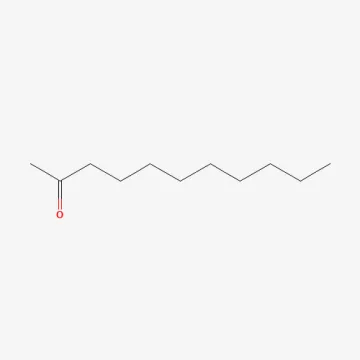
Methyl nonyl ketone
Description
Mode of action
Methyl nonyl ketone, also known as 2-undecanone, is a naturally occurring compound that belongs to the class of aliphatic ketones. It is primarily utilized in agriculture for its potent repellent properties rather than as a lethal insecticide.
The mechanism of action involves the compound acting as a sensory deterrent. It targets the olfactory receptors of various pests and animals, creating an environment that is undesirable for them, which leads to their avoidance of the treated area.
Because it is not a systemic toxin, it does not accumulate within plant tissues. Instead, it functions as a protective barrier on the surface of leaves or soil, making it a suitable choice for sustainable farming practices and integrated pest management.
The compound's effectiveness is largely due to its volatility, which allows it to release an odor that masks the scent of the crop, thereby reducing the attractiveness of the plant to potential pests.
The persistence of the repellent effect is dependent on environmental conditions such as humidity, UV exposure, and temperature, which influence the rate of evaporation of the ketone from the treated surfaces.
What it targets
Methyl nonyl ketone is widely used to deter animals such as dogs, cats, rabbits, and rodents from damaging nursery stock, ornamental plants, and vegetable gardens.
It is effectively deployed in field conditions to prevent the trampling or gnawing of young seedlings, which are particularly susceptible to animal browsing during the early stages of growth.
Additionally, it has applications against certain insect pests that rely on host-plant volatiles for orientation, helping to protect sensitive crops without resorting to broad-spectrum toxic chemicals.
By preventing mechanical damage caused by larger animals, the compound also helps to mitigate the spread of secondary infections caused by fungi or bacteria that typically enter through open wounds.
It is commonly used by professional growers to secure trial plots and high-value crops from unauthorized entry by small wildlife, ensuring stable conditions for plant development.
Rates and timing
The application rates for methyl nonyl ketone vary based on the specific formulation, the target species, and the crop type being protected. It is typically applied as a spray or in granular form around the perimeter of the target area.
For liquid sprays, consistent and uniform coverage is essential to ensure that the olfactory barrier remains intact. Frequent reapplication may be necessary during periods of high precipitation.
In most scenarios, a re-treatment interval of 7 to 14 days is recommended to maintain optimal repellent activity, although this can be adjusted based on local weather observations.
When used in greenhouse environments, lower application rates are often sufficient because the plants are shielded from direct rainfall and extreme wind, allowing for a longer lasting protective effect.
Using surfactants or specialized spreaders in the tank mix can improve the adherence of the compound to waxy plant surfaces, thereby increasing the durability of the repellent barrier.
Restrictions
While generally considered safer than conventional pesticides, methyl nonyl ketone should be handled with standard care, including the use of gloves and eye protection to prevent direct contact.
Always adhere to the specific pre-harvest intervals (PHI) listed on the product label to ensure that residues do not interfere with food safety requirements or export standards.
Care should be taken to avoid runoff into aquatic ecosystems, as concentrated amounts of the substance may affect local water quality and aquatic organisms.
Storage should be in a cool, well-ventilated location away from direct sunlight to prevent the thermal degradation of the active ingredient and ensure its shelf-life.
- Wear appropriate PPE when applying the product.
- Avoid spraying during high wind conditions to prevent drift.
- Keep containers tightly sealed when not in use.
Status in the European Union
Not approved in the EU
- CAS number
- 112-12-9
- Category (EU)
- RE - Repellant
- ADI
- Not appl.
- ARfD
- Not appl.
- AOEL
- Not appl.
EU status is for reference only and does not replace national registration in your country.