
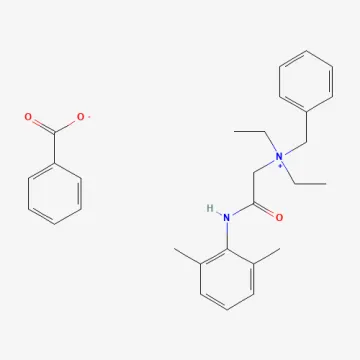
Denatonium benzoate
Description
Mode of action
Denatonium benzoate is a chemical compound widely recognized as the bitterest substance in the world. In the context of agronomy and crop protection, it does not function as a toxic pesticide designed to kill pests directly.
The primary mechanism of action of this substance is to create a powerful taste barrier. Upon contact with a treated surface or an attempt to ingest treated seeds, animals and insects experience an immediate reaction of repulsion due to the extreme bitterness.
This substance acts as an aversive agent (repellent) that "teaches" unwanted consumers to avoid the treated object. It effectively blocks the feeding instinct, protecting agricultural resources from being eaten by birds, rodents, and other wild animals.
Chemically, the compound is highly stable, which allows it to maintain its organoleptic properties in various field conditions. It has low volatility and high adhesion capacity to the substrates to which it is applied.
The use of denatonium benzoate in agrochemical formulations promotes the humane limitation of damage caused to crops, minimizing the need for lethal methods of population control for wild animals.
What it targets
The primary targeted use of denatonium benzoate is seed treatment to protect against ingestion by birds and small rodents. During the spring sowing campaign, this is a critical stage for maintaining optimal crop stand density.
The substance effectively protects seeds of cereals, corn, sunflowers, and vegetable crops from pests such as rooks, pheasants, field mice, and ground squirrels. It prevents the digging up and destruction of seeds from the soil immediately after sowing.
Furthermore, the compound can be used in formulations for treating tree bark in nurseries and young orchards. This prevents trunk damage by hares and other rodents during the winter period when access to other food sources is limited.
Denatonium benzoate is also used in the preparation of insecticide baits. This helps prevent the accidental ingestion of poisonous baits by domestic or beneficial non-target animals, which react to the bitter taste before consuming a toxic dose.
Using it as an additive to pesticides improves the safety of industrial processes by preventing accidental ingestion of chemicals by personnel or wildlife in storage and application areas.
Rates and timing
Application rates of denatonium benzoate are extremely low, as the bitterness perception threshold in mammals and birds is very low. Even small concentrations in the working solution provide a persistent repellent effect.
Application timing is strictly tied to the moment of sowing agricultural crops. Treatment is carried out well in advance during seed material preparation (seed dressing) or immediately before filling the seed drill.
The preparation can be applied in dry form combined with stickers or in liquid seed dresser formulations. An important requirement is the uniform distribution of the substance across the entire seed surface to avoid unprotected areas.
For the protection of woody crops, treatment is carried out before the onset of winter frosts. The solution is applied to the lower part of the trunk using sprayers or brushes to ensure a dense protective layer.
When used in baits, the concentration is selected so as not to reduce the attractiveness of the bait for the target pest while remaining perceptible to non-target objects.
Restrictions
Despite its high safety for the environment, denatonium benzoate requires adherence to standard precautions when working with concentrated chemicals.
Operators involved in seed treatment processes must use personal protective equipment for skin and respiratory protection to avoid contact with dust forms of the preparation.
It is important to store the substance separately from food and animal feed in tightly closed containers. Despite its bitterness, it is necessary to prevent the concentrate from entering drinking water or open water bodies.
The efficacy of the repellent can decrease during heavy precipitation if the substance was applied to the surface of plants or tree trunks without the use of specialized fixing agents or stickers.
One must strictly follow the instructions of the specific manufacturer, as denatonium benzoate is often supplied as part of multi-component mixtures, where its action is complemented by other active agents.
Status in the European Union
Not approved in the EU
- CAS number
- 3734-33-6
- Category (EU)
- RE - Repellant
- Approved from
- 01.09.2009
- Approval until
- 01.12.2020
- ADI
- Not appl.
- ARfD
- Not appl.
- AOEL
- Not appl.
EU status is for reference only and does not replace national registration in your country.