

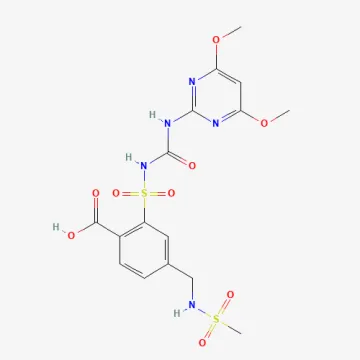
Description
Mode of action
Mesosulfuron-methyl belongs to the sulfonylurea chemical class. It is a systemic herbicide with selective action that penetrates the plant primarily through the leaves and partially through the root system.
The primary mechanism of action involves blocking the acetolactate synthase (ALS) enzyme in susceptible plants. This leads to the cessation of the synthesis of essential amino acids — valine, leucine, and isoleucine.
As a result of metabolic disruption, cell division stops at growth points, causing the weed's development to halt within just a few hours after application.
Initial visual symptoms of impact, such as chlorosis and necrosis, appear 5 to 10 days after application. Complete weed mortality occurs within 2 to 4 weeks.
The substance is characterized by high selectivity due to the ability of crop plants, particularly wheat, to rapidly metabolize and neutralize the active ingredient without causing harm to the main crop.
What it targets
Mesosulfuron-methyl is an effective tool for controlling a wide spectrum of annual grass weeds and certain broadleaf weeds.
The product is most effective against such notorious crop pests as silky bentgrass, black-grass, wild oats, and various brome species.
Suppression of several broadleaf weeds is also observed, making it a comprehensive solution for maintaining clean cereal fields during the spring period.
To improve efficacy against broadleaf weeds, mesosulfuron-methyl is often applied in mixtures with other herbicides, which expands the spectrum of the product's action.
- Silky bentgrass (Apera spica-venti)
- Wild oats (Avena fatua)
- Black-grass (Alopecurus myosuroides)
- Brome (Bromus spp.)
Rates and timing
Application rates for mesosulfuron-methyl depend on the weed species composition and their growth stage. Generally, treatment is carried out during early weed growth phases.
The optimal time for application is during the period of active weed growth, from the 2-leaf stage to the start of tillering, when weeds are most vulnerable to the product.
Crop plants (winter and spring wheat) are most tolerant to the product from the start of tillering to the stem elongation stage, which constitutes the recommended application window.
In tank mixtures with adjuvants, the substance's uptake efficiency increases significantly, allowing for results even under unfavorable weather conditions.
It is important to ensure high-quality coverage of the leaf surface with the working solution, making the use of high-quality nozzles a mandatory condition for uniform distribution.
Restrictions
Treatment should not be conducted when the crop is under significant stress, such as drought, frost, or after sudden temperature fluctuations.
Mesosulfuron-methyl may have residual soil activity, so crop rotation plans must take into account the specific product regulations and soil type.
When handling the substance, standard personal protective equipment (gloves, goggles, and respirators) must be used to prevent contact with skin and mucous membranes.
Avoid spray drift onto neighboring fields with sensitive crops, especially if broadleaf plantings are located nearby.
Store products based on mesosulfuron-methyl in their original packaging, away from food and animal feed, and in accordance with warehouse temperature requirements.
Regulatory
Status in the European Union
Approved in the EU
- CAS number
- 400852-66-6
- Approved from
- 01.07.2017
- Approval until
- 30.06.2032
- ADI
- 1.0 mg/kg bw/day
- ARfD
- Not appl.
- AOEL
- 0.13 mg/kg bw/day
EU legislation
EU status is for reference only and does not replace national registration in your country.
Content graph
Connections · Mesosulfuron-methyl
Most often together:
Marketplace
Products · 2
