

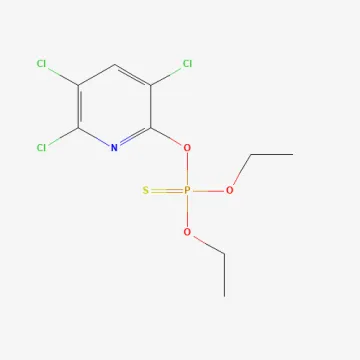
Description
Mode of action
Chlorpyrifos is a non-systemic organophosphate insecticide that acts through contact, ingestion, and vapor phase (fumigation) mechanisms.
The chemical interferes with the nervous system of insects by inhibiting the enzyme acetylcholinesterase, leading to an accumulation of acetylcholine, persistent nerve firing, paralysis, and death.
Its fast-acting nature provides an immediate knockdown effect, which is highly beneficial when insect populations reach critical levels rapidly.
The vapor action allows the active ingredient to penetrate dense crop canopies and treat soil-dwelling pests, reaching areas where direct spray contact is difficult.
It provides residual control, meaning that treated surfaces remain toxic to susceptible insects for a period ranging from one to three weeks post-application.
What it targets
It is used globally to manage a wide variety of pests across many crops including cereals, cotton, corn, fruits, and vegetables.
Primary targets include lepidopteran larvae, coleopteran adults and larvae, aphids, mites, and various soil-inhabiting pests.
It is particularly effective against tough pests like cutworms, rootworms, and stalk borers that are often protected by plant foliage.
In addition to field applications, it is utilized in professional pest control for structural and household protection against termites and cockroaches.
It helps in controlling major agricultural threats, significantly reducing crop losses caused by foliage-feeding and root-damaging organisms.
Rates and timing
Application rates depend heavily on the crop type, target pest species, and formulation concentration, typically ranging between 0.5 and 2.5 liters per hectare.
For optimal results, applications should be timed to coincide with the most vulnerable stages of the pest lifecycle, often based on scouting reports.
Equipment calibration is essential to ensure adequate coverage, particularly when targeting pests that reside on the underside of leaves or within the soil surface.
The solution should be applied when weather conditions are calm, preferably during cooler parts of the day, to minimize drift and photodegradation.
Consult the specific product label for detailed dosage instructions, as different concentrations of the active ingredient are available on the market.
Restrictions
Chlorpyrifos is highly toxic to bees, birds, and aquatic organisms, requiring strict adherence to environmental safety protocols.
Buffer zones must be maintained near water bodies and sensitive ecological areas to prevent contamination and unintended environmental impact.
Strict re-entry intervals (REI) and pre-harvest intervals (PHI) must be respected to ensure the safety of farm workers and end consumers.
Personal Protective Equipment (PPE), including chemical-resistant suits and respirators, is mandatory for all personnel handling the concentrated product.
Due to health and environmental concerns, many jurisdictions have restricted or phased out the use of chlorpyrifos, making it crucial to verify local regulations.
Regulatory
Status in the European Union
Not approved in the EU
- CAS number
- 2921-88-2
- Category (EU)
- IN - Insecticide
- Approved from
- 01.07.2006
- Approval until
- 16.01.2020
- ADI
- Not appl.
- ARfD
- Not appl.
- AOEL
- Not appl.
Hazard classification (CLP)
Acute Tox. 3 - H301Aquatic Acute 1 - H400Aquatic Chronic 1 - H410
EU legislation
EU status is for reference only and does not replace national registration in your country.
Content graph
Connections · Chlorpyrifos
Most often together:
Marketplace
Products · 112


Chlorpyrifos - Agro
«Нанджин Ессенс Файн-Кемікал Ко. Лтд» (Китай)
Insecticides
0
0
·
45
5 offers
5.66 €per 1 l
Buy

Dragun, KE
Nanjing No.1 Pesticide Factory of Red Sun Group Co., Ltd.
Insecticides
0
0
·
45
1 offer
24.91 €per 1 l
Buy


Killer, EC, (chlorpyrifos, 500 g/l + cypermethrin, 50 g/l)
Трастхім Ко. Лтд., Нанджин, Китай
Insecticides
0
0
·
42
2 offers
8.72 €per 1 l
Buy


PIRINEX SUPER 420 K.E.
F. Macteshim Chemical Works, LLC
Insecticides
0
0
·
40
1 offer
13.47 €per 1 l
Buy

Sufron
ТОВ «Фабрика агрохімікатів», Черкаси, Україна
Insecticides
0
0
·
40
1 offer
0.89 €per 1 l
Buy

Nirvana
ТОВ «Фабрика агрохімікатів», Черкаси, Україна
Insecticides
0
0
·
39
5 offers
8.28 €per 1 l
Buy


Superkil Forte 550 EC
Фадер Альянс Лтд., Великобританія (Fader Alliance Ltd., England) на заводах Нідерландів, Польщі
Insecticides
0
0
·
33
3 offers
0.95 €per 1 l
Buy

Dragun EC
Nanjing No.1 Pesticide Factory of Red Sun Group Co., Ltd.
Insecticides
0
0
·
31
1 offer
0.89 €per 1 l
Buy

Rembek
Scientific-Production Company "Kvadrat", LLC
Insecticides
0
0
·
29
57 offers
0.74 €per 1 l
Buy

Dragun
Nanjing No.1 Pesticide Factory of Red Sun Group Co., Ltd.
Insecticides
0
1
·
2.3K
No offers
—
Details


Fospirat, KE / Cipermetrin Plus, KE
«МАК ГмбХ» («MAC GmbH»), Зігмарсціль Німеччина
Insecticides
0
0
·
48
No offers
—
Details

Superkil 440, EC, (chlorpyrifos, 400 g/l + cypermethrin, 40 g/l)
Агріфар С.А.(Бельгія
Insecticides
0
0
·
47
No offers
—
Details

Chlorcyp-Star
ТОВ «Фабрика агрохімікатів», Черкаси, Україна
Insecticides
0
0
·
47
No offers
—
Details

Norton, c.e.
Ф.Суперус Ко ., Лтд., Гонг-Конг, Шанхай, Китай.
Insecticides
0
0
·
44
No offers
—
Details

Dragun c.e.
Nanjing No.1 Pesticide Factory of Red Sun Group Co., Ltd.
Insecticides
0
0
·
43
No offers
—
Details



Chlorpyrifos-Agro
ТОВ «Фабрика агрохімікатів», Черкаси, Україна
Insecticides
0
0
·
33
No offers
—
Details