

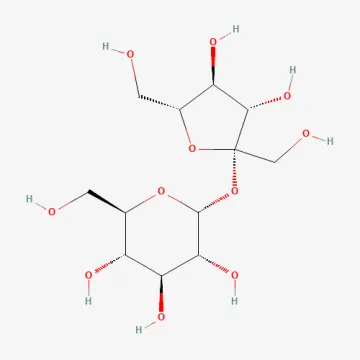
Description
Mode of action
Sucrose, a disaccharide, does not act as a classic pesticide active ingredient; however, it is widely utilized in agrochemistry as a vital component of auxiliary formulations. Within plant protection products, it is often used as a stabilizer or adjuvant to improve the wetting and penetration of active ingredients through the leaf cuticle.
The mechanism of sucrose influence relates to its ability to modify the physicochemical properties of the spray solution. The presence of sugars in the formulation promotes the formation of a more uniform film on the plant's vegetative organs, which prevents rapid droplet evaporation.
Physiologically, exogenous sucrose application assists plants during stress periods by acting as an energy substrate. It maintains the osmotic potential of cells, which is critical when spraying under drought conditions or temperature fluctuations.
Sucrose promotes more efficient absorption of systemic pesticides by stimulating metabolic processes within epidermal cells. Enhanced metabolism induced by carbohydrates allows the plant to redistribute the active ingredient throughout its tissues more rapidly.
The use of sucrose in tank mixes helps to reduce the phytotoxicity of harsh chemical compounds. Due to its binding properties, it acts gently on tissues, lowering the risk of chemical burns during intensive chemical protection programs.
What it targets
Products containing sucrose are used to prevent stress states in crop plants during herbicide treatments. While it does not act directly on pests or disease pathogens, it increases the overall resilience of crops against unfavorable environmental factors.
In integrated pest management practices, sucrose serves as an auxiliary component to enhance the effectiveness of foliar fertilizers. It helps the plant absorb micronutrients included in complex tank mixes more effectively.
Applications include field crops such as cereals, maize, and sunflowers, as well as horticultural crops during periods of active vegetative growth. The use of sucrose is justified when applications are necessary under adverse weather conditions.
The use of this component is aimed at preventing yield loss caused by pesticide-induced stress. It effectively neutralizes the negative impact of herbicide residual activity on sensitive crop varieties.
Sucrose is increasingly used in new-generation biostimulants designed to increase the adaptive potential of agricultural crops in climatically unstable growing regions.
Rates and timing
Application rates for sucrose as an adjuvant are typically based on the spray volume, ranging from 0.5% to 2% concentration. Exact proportions depend on the specific type of pesticide and the condition of the crop's vegetative mass.
Optimal application timing coincides with phases of intensive growth when the plant has an increased demand for energy resources. In tank mixes with herbicides, sucrose application is recommended to be carried out synchronously with the main spray treatment.
It is recommended to apply during morning or evening hours under moderate solar activity. This allows the formulation components to be absorbed better, while sucrose performs its function as a stabilizer until the spray deposit is fully dry.
When preparing the solution, dissolve the sugar in a small amount of water before adding the concentrate to the sprayer tank. It is essential to follow the mixing order to prevent the precipitation of protection components.
In cases of application within complex mixes with fungicides, the dosage may be adjusted downwards. A preliminary compatibility test in small containers is recommended before filling the main sprayer tank.
Restrictions
Sucrose is a biologically active substance, so one must consider the risk of attracting pests that feed on sugary exudates. Exceeding recommended concentrations is not advised to avoid dust accumulation and the development of sooty molds.
A significant limitation is the substance's high hygroscopicity, which requires special storage conditions for concentrates. Moisture ingress into containers with sugar-containing products must be avoided to prevent premature fermentation.
The use of sucrose is not permitted in protection systems where formulation components are incompatible with organic sugars. Always check the pesticide manufacturer's recommendations regarding the use of carbohydrate-based adjuvants.
Application of sucrose is discouraged in conditions of high disease pressure, as excess carbohydrates on the leaf surface may create a nutrient-rich environment for pathogens. In such cases, synthetic surfactants should be preferred.
Storage of spray solutions with added sucrose for more than 4–6 hours is not recommended. Over time, microbiological processes may begin in the solution, reducing the efficacy of the targeted pesticide active ingredients.
Regulatory
Status in the European Union
Approved in the EU
- CAS number
- 57-50-1
- Category (EU)
- EL - Elicitor
- Approved from
- 17.07.2020
- ADI
- Not appl.
- ARfD
- Not appl.
- AOEL
- Not appl.
EU legislation
EU status is for reference only and does not replace national registration in your country.
Content graph
Connections · Sucrose
Most often together:
Marketplace
Products · 2
