
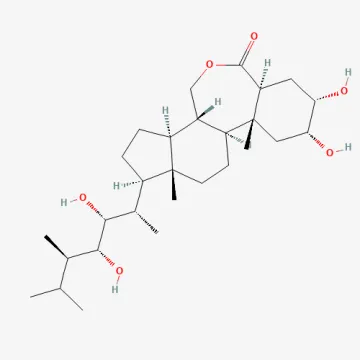
24-Epibrassinolide
Description
Mode of action
24-Epibrassinolide belongs to the brassinosteroid class, which are steroidal plant hormones responsible for regulating major physiological processes. It acts as a signaling molecule that activates genes essential for plant growth and stress management.
The mechanism of action involves modulating enzyme activity and optimizing energy metabolism. It promotes cell division and root system development, which ensures the vigorous growth of crops during the early stages of the vegetative cycle.
A key feature of this substance is its significant anti-stress activity. It stabilizes cell membranes, prevents chlorophyll degradation, and enhances antioxidant enzyme activity, helping plants withstand drought, salinity, and freezing temperatures.
The hormone triggers the synthesis of proteins and nucleic acids, accelerating the regeneration of plant tissues. This makes it an ideal solution for recovering crops after pesticide-induced phytotoxicity or physical damage.
Due to its high biological activity, only very low concentrations are required, which makes it a highly efficient and environmentally friendly tool in modern agricultural practices.
What it targets
This compound is used on a wide range of crops, including cereals, corn, vegetables, fruits, and vines. It is equally effective in open-field farming and controlled-environment greenhouses.
It protects crops from the phytotoxic impact of herbicides, reducing stress and allowing plants to recover their growth pace. It is also effective during periods of extreme moisture, soil salinity, or sharp temperature fluctuations.
Application aims to enhance yield quality, including higher sugar content in fruits, improved uniformity of crops, and extended shelf life of harvested produce, thus increasing market value.
Used for seed treatment, it ensures uniform and robust germination even under unfavorable weather conditions during the early spring planting season.
It strengthens the natural immune status of plants, indirectly increasing resistance to various fungal and bacterial infections by reinforcing the plant's structural and biochemical defense barriers.
Rates and timing
Seed treatment is conducted via soaking or dressing. Application rates depend on the specific crop variety and the concentration of the active ingredient in the commercial formulation provided by the manufacturer.
Foliar application is recommended during critical growth stages. Optimal effects are observed when applied during tillering, budding, or flowering, when the crop's physiological demand for hormonal regulation is at its peak.
It shows good compatibility with most fertilizers, but tank-mix compatibility tests with pesticides are mandatory to avoid precipitation. Avoid mixing with highly alkaline substances.
The frequency of treatment depends on the overall crop management strategy. Typically, one or two applications per season are sufficient to stabilize metabolism and maintain growth momentum during climatic stress.
For maximum efficacy, ensure uniform spray coverage on leaves. It is best to apply during early morning or late evening hours to minimize evaporation and ensure proper uptake by the plant.
Restrictions
While 24-epibrassinolide is environmentally safe, users should follow standard handling precautions when dealing with concentrates, such as wearing protective gloves and clothing to avoid skin irritation.
Do not exceed the recommended dosages. Excessive concentrations of growth regulators may disrupt the internal hormonal balance, potentially leading to a temporary growth inhibition rather than the desired stimulation.
There are generally no mandatory pre-harvest intervals, as the substance is a natural metabolite that degrades rapidly into non-toxic compounds within plant tissues.
Storage should be in a cool, dark place away from direct sunlight and heat, as steroidal molecules can degrade when exposed to prolonged ultraviolet radiation or high temperatures.
Application is not recommended during the deep dormancy phase or when plant development has ceased due to irreversible physiological damage, as hormonal stimulation will be ineffective in such cases.
Status in the European Union
Approved in the EU
- CAS number
- 78821-43-9
- Category (EU)
- EL - Elicitor
- Approved from
- 31.03.2021
- Approval until
- 31.03.2036
EU status is for reference only and does not replace national registration in your country.