

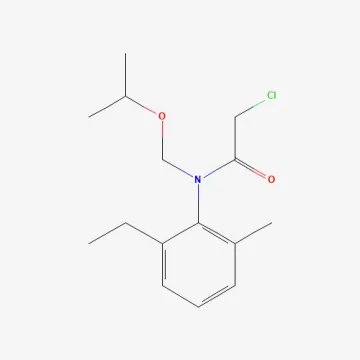
Description
Mode of action
Propisochlor belongs to the chloroacetanilide chemical class and acts as a highly effective selective soil-applied herbicide. The active ingredient inhibits cell division and protein synthesis in the meristematic tissues of weed seedlings, effectively stopping their growth at the very earliest stages.
The mode of action involves the suppression of specific enzymes, leading to severe metabolic disruption in weed seedlings. Consequently, susceptible weeds perish before emerging from the soil surface, providing early season control.
The herbicide is absorbed primarily through the seedlings and root system of weeds germinating from seeds. Due to its moderate mobility in the topsoil layer, it establishes a stable herbicidal barrier that remains active against new weed flushes.
Selectivity is achieved because target crops can metabolize the active ingredient, neutralizing its toxic effect within their tissues. This makes propisochlor a safe option for crop protection when application regulations are strictly followed.
The residual activity of propisochlor typically lasts between 4 to 8 weeks, which is vital for protecting the crop during the critical early development phase when competition from weeds is most damaging.
What it targets
The primary target range of propisochlor includes annual grass weeds such as barnyard grass, foxtails, and various types of panicum that frequently threaten row crops.
The compound also demonstrates effectiveness against several broadleaf weed species, providing a comprehensive protective spectrum during the initial stages of crop growth.
Sensitive weed species include:
- Barnyard grass (Echinochloa crus-galli)
- Foxtail (Setaria spp.)
- Large crabgrass (Digitaria sanguinalis)
- Common lambsquarters (Chenopodium album)
- Black nightshade (Solanum nigrum)
It is important to note that propisochlor has little to no systemic effect on established perennial weeds with deep root systems, as its action is directed specifically at germinating seeds.
In cases of heavy infestation with diverse weed populations, tank mixtures with other herbicides are often employed to broaden the control spectrum and ensure clean fields.
Rates and timing
Propisochlor is applied via soil spraying before crop sowing, during sowing, or pre-emergence, generally no later than 5 days after the crop has been seeded.
Application rates depend significantly on soil texture and organic matter content. Lighter, sandy soils require lower doses, whereas heavier clay soils or soils with higher humus content necessitate increased rates for stable effectiveness.
Optimal control is achieved under moist soil conditions. In dry weather, efficiency may decrease, often requiring shallow incorporation of the herbicide into the soil (2-3 cm) using light harrows.
Technical precision is paramount during application to ensure even coverage across the field. Poor distribution, including overlaps or skips, can lead to decreased efficiency or potential crop injury.
The timing of application is critical; the treatment must be completed before weeds emerge, as the herbicide has limited efficacy against already established vegetative weed plants.
Restrictions
Mechanical soil cultivation after application is strongly discouraged, as this disrupts the herbicidal film, allowing new weed seeds to germinate and emerge, thereby negating the protective effect.
While propisochlor generally does not leave problematic residues for subsequent crops in a standard rotation, adherence to recommended dosage limits is essential to maintain soil health.
Use on soils with extremely high organic matter content may reduce herbicide performance because the organic particles strongly adsorb the active ingredient, making it less available for weed uptake.
Avoid contact with emerged crop plants to prevent temporary phytotoxicity, which can manifest as stunted growth or delayed development in the early stages.
Personal Protective Equipment (PPE) is mandatory for all handlers. Operators must use respirators, protective clothing, goggles, and chemical-resistant gloves to prevent contact with the skin and eyes.
Content graph
Connections · Propisochlor
Most often together:
Marketplace
Products · 71

Proponit 720 g/l
Аріста ЛайфСайенс С.А.С., Ногер, Франція
Herbicides
0
0
·
81
2 offers
22.59 €per 1 l
Buy


Proxanil 720, EC
Фадер Альянс Лтд., Великобританія (Fader Alliance Ltd., England) на заводах Нідерландів, Польщі
Herbicides
0
0
·
61
3 offers
7 €per 1 l
Buy


Proponet T, SE
Аріста ЛайфСайенс С.А.С., Ногер, Франція
Herbicides
0
0
·
59
1 offer
7.88 €per 1 l
Buy


Proponit@720
Аріста ЛайфСайенс С.А.С., Ногер, Франція
Herbicides
0
0
·
57
2 offers
22.59 €per 1 l
Buy


Astra, KE (propizochlor, 720 g/l)
«Нанджин Ессенс Файн-Кемікал Ко. Лтд» (Китай)
Herbicides
0
0
·
55
1 offer
6.27 €per 1 l
Buy


Ladon Pro, KE (propizochlor, 720 g/l)
ТОВ «Франдеса» , Республіка Білорусь
Herbicides
0
0
·
50
1 offer
4.6 €per 1 l
Buy


Propozit, EC, (Propizochlor, 720 g/l)
China Chemical Industrial & Rice Co. Ltd
Herbicides
0
0
·
49
1 offer
5.78 €per 1 l
Buy


ProLan, KE (propizochlor, 720 g/l)
Hangzhou Ruijiang Chemical Co., Ltd, КНР
Herbicides
0
0
·
45
1 offer
153.48 €per 1 l
Buy


Grinfort Pronit, EC (propyzochlor, 720 g/L)
АгроМаксі, ТОВ
Herbicides
0
0
·
44
4 offers
4.87 €per 1 l
Buy


Proponet Duo, EC
Аріста ЛайфСайенс С.А.С., Ногер, Франція
Herbicides
0
0
·
35
5 offers
6.98 €per 1 l
Buy

Propazox, EC
ф.« Harbin Limin Agrochemical Technology Co., Ltd.», Province, China;
Herbicides
0
0
·
33
4 offers
4.74 €per 1 l
Buy

Sora-net, KE (propizoxil, 720 g/l)
Hangzhou Ruijiang Chemical Co., Ltd.
Herbicides
0
0
·
33
4 offers
6.09 €per 1 l
Buy

Belenus, KE (propyzochlor, 720 g/l)
Jiangsu FarmingChem Co., LTD, КНР
Herbicides
0
0
·
32
5 offers
4.59 €per 1 l
Buy


Proza, KE (propizochlor, 720 g/l)
Shandong Binnong Technology Co., Ltd., Китай, Superus Co. LTD, Китай
Herbicides
0
0
·
81
No offers
—
Details


