

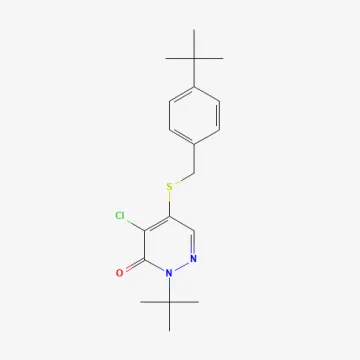
Description
Mode of action
Pyridaben belongs to the pyridazinone chemical class and is a potent contact insectoacaricide. Its main task is to suppress the mobile stages of pest development.
The mechanism of action of the substance consists in inhibiting the process of oxidative phosphorylation in the mitochondria of insect and mite cells. This leads to the disruption of energy metabolism in the pest's body.
The product affects the nervous system of parasites, causing paralysis and rapid death. The effect is observed within just a few minutes after direct contact with the working solution.
An important feature of pyridaben is its high translaminar activity. The substance is able to penetrate leaf tissues, providing protection even to those parts of the plant that the solution did not hit directly.
The active substance has a long residual effect, which allows for restraining the reappearance of pests for several weeks after treatment.
What it targets
Pyridaben is effective against a wide range of phytophagous mites: spider mites, fruit mites, grape mites, gall mites, and other species.
In addition to acaricidal action, the substance demonstrates insecticidal activity against a number of insects, including whiteflies, thrips, and leafhoppers.
The product is successfully used in the protection of pome and stone fruit crops, vineyards, vegetable crops in greenhouses and open fields, as well as ornamental plants.
A key advantage is the impact on all stages of pest development, from larvae to adults, which significantly reduces the total population size.
Due to its selectivity, the substance can be used in integrated orchard protection programs, provided that dosage regulations are strictly followed.
Rates and timing
The consumption rates of the preparation depend on the crop type and pest density, ranging on average from 0.5 to 1.5 liters or kilograms of product per hectare.
The optimal timing for treatment occurs during the growing season upon detecting the first signs of pest activity, without waiting for mass infestation of plants.
To achieve the best results, it is necessary to ensure uniform and thorough wetting of the leaf surface, including the underside of the leaf.
The frequency of treatments per season is usually limited to one or two procedures to prevent the formation of resistance in harmful organisms.
The interval between the last treatment and harvest must strictly comply with the instructions for the specific product (usually from 20 to 30 days).
Restrictions
Pyridaben is classified as a moderately hazardous substance, therefore, personal protective equipment for skin and respiratory organs must be used during application.
The product exhibits high toxicity to bees and other beneficial insects; therefore, treatments are prohibited during the flowering period of crops.
It is not recommended to use this substance near fishery reservoirs due to its potential danger to aquatic organisms.
To manage resistance, it is recommended to rotate pyridaben with acaricides from other chemical groups to avoid mites developing immunity to the active substance.
The product must be stored in dry, cool warehouse facilities, inaccessible to children and pets, and away from food products.
Content graph
Connections · Pyridaben
Most often together:
Marketplace
Products · 17


Floristin
ТОВ «Фабрика агрохімікатів», Черкаси, Україна
Insecticides
0
0
·
68
27 offers
4.7 €per 1 l
Buy

Taurus, granular, (pyridaben, 200 g/kg)
Санрайз Кемікалз Ко. Лтд., Шанхай, Китай
Insecticides
0
0
·
65
4 offers
16.36 €per 1 l
Buy


Taurus z.p., Insecticide (pyridaben 200 g/kg)
Санрайз Кемікалз Ко. Лтд., Шанхай, Китай
Insecticides
0
0
·
50
4 offers
18.09 €per 1 l
Buy


ANTI-ACARI-MAX
ТОВ «Фабрика агрохімікатів», Черкаси, Україна
Insecticides
0
0
·
35
6 offers
3.02 €per 1 l
Buy

Anti-Scab Pro
ТОВ «Фабрика агрохімікатів», Черкаси, Україна
Insecticides
0
0
·
32
17 offers
18.6 €per 1 l
Buy
