

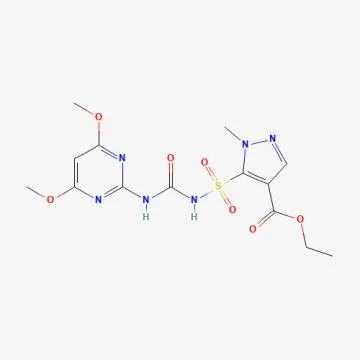
Active ingredient
Especially harmful
Pyrazosulfuron-ethyl
Description
Mode of action
Pyrazosulfuron-ethyl belongs to the sulfonylurea chemical class. It is a systemic herbicide that is rapidly absorbed by the root system and foliage of weeds, subsequently translocating through the xylem and phloem to the growth points.
The primary mode of action involves the inhibition of the acetolactate synthase (ALS) enzyme. Blocking this enzyme stops the synthesis of essential amino acids, such as valine, leucine, and isoleucine.
Due to the arrest of cell division, the growth of susceptible weeds ceases within hours of application. Visual symptoms of chlorosis and necrosis appear within a few days.
Complete weed death occurs within 2 to 3 weeks after treatment, depending on ambient temperature and weed species composition. The product exhibits high selectivity towards the crop.
The active ingredient also possesses significant soil-residual activity, creating a protective barrier that prevents the emergence of new weed sprouts for a certain period after application.
What it targets
The product is designed to control a broad spectrum of annual and perennial broadleaf weeds, as well as certain sedge species in rice paddies.
It effectively suppresses the following weed species:
- Scirpus spp. (bulrush);
- Cyperus spp. (nutsedge);
- Monochoria korsakowii;
- Sagittaria spp. (arrowhead);
- Various pondweed species.
Pyrazosulfuron-ethyl shows excellent results in controlling stubborn wetland weeds that compete with rice for nutrients and sunlight.
The herbicide is less effective against certain grass weeds; therefore, in crop protection practice, it is often included in tank mixtures with other herbicides to broaden the spectrum of action.
The use of this herbicide allows for reduced weed pressure in fields, which directly impacts the quality and volume of the commercial grain harvest.
Rates and timing
Application rates vary depending on agroclimatic conditions, weed growth stage, and application method, typically ranging from 15 to 30 grams of active ingredient per hectare.
When used in rice paddy systems, the herbicide is applied via spraying or through uniform distribution of granular formulations into the irrigation water.
Optimal timing for application is during the active growth phase of weeds, when they are most sensitive to sulfonylurea action, typically between the 2-leaf and 4-leaf stages.
Temperature plays a crucial role: the activity of the active ingredient increases at air temperatures between +15°C and +25°C, ensuring rapid systemic action.
It is not recommended to apply the product if night frosts are expected or immediately after extreme precipitation, as this may temporarily reduce efficacy or cause crop stress.
Restrictions
When handling pyrazosulfuron-ethyl, it is essential to strictly follow safety protocols, using personal protective equipment for skin, respiratory, and eye protection.
Disposal of residual working solution into water bodies and sewage systems is strictly prohibited. The product may be toxic to aquatic flora and fauna; therefore, when using aerial application, sanitary buffer zones must be observed.
Drift of the working solution onto neighboring crops susceptible to sulfonylurea herbicides, such as vegetables or sugar beets, must be avoided.
When preparing tank mixes, it is recommended to conduct a preliminary compatibility test to avoid precipitation or chemical degradation of the components.
Storage of the herbicide should be in dry, cool, and well-ventilated warehouses, in the original manufacturer packaging, away from food, beverages, and animal feed.
Content graph
Connections · Pyrazosulfuron-ethyl
Most often together:
Marketplace
Products · 2

SIRIUS z.p., (Pyrasulfuron-ethyl, 100 g/kg)
Nissan Chemical Corporation, LLC
Herbicides
0
0
·
34
No offers
—
Details