

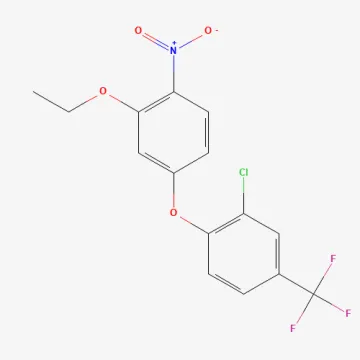
Description
Mode of action
Oxyfluorfen is a member of the diphenyl ether chemical class and acts as a contact, selective herbicide. Its primary target is the enzyme protoporphyrinogen oxidase.
When exposed to sunlight, the active ingredient triggers rapid lipid peroxidation in the cell membranes of plant tissues, leading to cell rupture.
This process results in quick necrosis and the death of susceptible weed species shortly after the application is performed.
The substance creates a stable chemical barrier on the soil surface, which effectively inhibits the germination of emerging weed seeds.
As a contact agent, it requires thorough coverage of plant foliage to ensure optimal efficacy against active weed growth.
What it targets
Oxyfluorfen is highly effective at managing a broad spectrum of annual broadleaf weeds found in various agricultural settings.
Commonly targeted species include Amaranthus, Chenopodium album, Solanum nigrum, and various Polygonum species which often infest crops.
It provides a robust solution for controlling weed populations that have developed resistance to other common herbicide classes.
While effective against broadleaves, its performance against grasses is generally moderate, often necessitating inclusion in tank mixtures.
- Amaranthus retroflexus
- Chenopodium album
- Solanum nigrum
- Polygonum spp.
- Portulaca oleracea
Rates and timing
Application rates are determined by the crop type, soil organic matter content, and the specific weed pressure at the time of treatment.
Dosages typically range from 0.5 to 2.0 liters per hectare, depending on the specific product formulation and the local agricultural requirements.
The best results are achieved when weeds are at the cotyledon stage or through pre-emergence application before the weeds break the surface.
Uniform soil coverage is critical during pre-emergence use to ensure the integrity of the protective herbicide barrier across the field.
Timing must be strictly aligned with the crop development stage to prevent potential phytotoxicity or stress to the main crop.
Restrictions
Oxyfluorfen does not possess systemic activity, meaning it cannot translocate within large or mature weeds to provide deep, whole-plant control.
Mechanical operations like cultivation should be avoided post-application to maintain the soil-applied herbicide film's continuity.
Direct contact with crop foliage must be prevented, as the compound can cause significant leaf scorch and tissue damage to the target crops.
Environmental conditions such as wind speed must be monitored during application to prevent drift into non-target areas or sensitive crops.
Always adhere to strict safety protocols and wear appropriate personal protective equipment (PPE) when handling and applying this herbicide.
Content graph
Connections · Oxyfluorfen
Most often together:
Marketplace
Products · 24


Zumur
F.A.GAN Chemical Manufacturers Ltd. Israel, member
Herbicides
0
0
·
67
2 offers
14.76 €per 1 l
Buy

GOAL 2E C.E.
ДоуАгроСаенсіс С.Р.Л.,Страда Стратале Італія
Herbicides
0
0
·
64
1 offer
26.27 €per 1 l
Buy

Farmer, EC, (oxifluorfen, 240 g/l)
Flagchem International Co., Ltd.
Herbicides
0
0
·
59
1 offer
114.21 €per 1 l
Buy


Farmer, c.e., Oxiflufen
Санрайз Кемікалз Ко. Лтд., Шанхай, Китай
Herbicides
0
0
·
58
3 offers
25.99 €per 1 l
Buy

Farmer c.e., (Oxifluorfen, 240 g/l)
Санрайз Кемікалз Ко. Лтд., Шанхай, Китай
Herbicides
0
0
·
50
2 offers
22.07 €per 1 l
Buy


Galigan, EC (oxifluorfen, 240 g/l)
Adam Aghan Ltd., Israel
Herbicides
0
0
·
33
2 offers
5.74 €per 1 l
Buy


Zumur CS, herbicide (Glyphosate, 360 g/l + Oxifluorfen, 30 g/l)
F.A.GAN Chemical Manufacturers Ltd. Israel, member
Herbicides
0
0
·
26
1 offer
121.17 €per pack
Buy
Oxigard EC, KE
Шаньдун Чіаочан Кемікал Ко. Лтд. (SHANDONG QIAOCHANG CHEMICAL CO., LTD)
Herbicides
0
0
·
74
No offers
—
Details

Farmer, EC, Herbicide (Oxyfluorfen 240 g/l)
Санрайз Кемікалз Ко. Лтд., Шанхай, Китай
Herbicides
0
0
·
51
No offers
—
Details

Galigan 240 EC, herbicide
F.A.GAN Chemical Manufacturers Ltd. Israel, member
Herbicides
0
0
·
49
No offers
—
Details


