

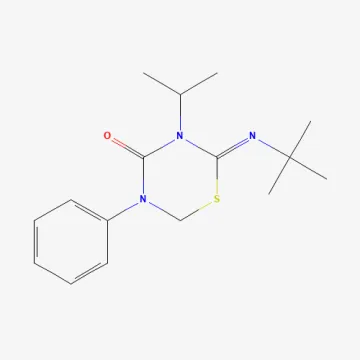
Description
Mode of action
Buprofezin belongs to the thiadiazine chemical class. It serves as a specialized insecticide functioning as an insect growth regulator (IGR) that inhibits chitin synthesis.
The mechanism of action involves disrupting the chitin synthesis process in pest larvae. The substance interferes with the molting process, preventing insects from transitioning to the next developmental stage, which leads to their death.
An important feature of buprofezin is that it does not provide an immediate "knockdown" effect on adult insects. However, it sterilizes adults, reducing their fecundity and suppressing the laying of viable eggs.
The product exhibits pronounced contact and stomach activity and displays moderate translaminar properties, allowing it to affect pests residing on the underside of leaves.
The duration of the protective effect typically ranges from 14 to 21 days, depending on weather conditions, the level of infestation, and the specific pest species present.
What it targets
Buprofezin is primarily specialized for controlling insects of the order Homoptera. It is highly effective against whiteflies, mealybugs, leafhoppers, and scale insects.
The substance effectively suppresses populations of greenhouse whiteflies, tobacco whiteflies, and various types of soft scales in both greenhouse and open-field conditions.
It is applied to a wide range of crops, including vegetables (tomatoes, cucumbers, eggplants), fruit trees (citrus), vineyards, and ornamental flower plants.
- Greenhouse whitefly (Trialeurodes vaporariorum)
- Mealybugs (Pseudococcidae)
- Leafhoppers (Cicadellidae)
- Scale insects and soft scales (Coccidae)
Due to its selectivity, buprofezin has minimal impact on beneficial entomophages, making it a valuable component of integrated pest management (IPM) programs.
Rates and timing
Application rates vary depending on the specific formulation and crop group. The standard working concentration is typically 0.5–1.0 kg of active ingredient per hectare.
When treating fruit crops and vineyards, it is crucial to ensure thorough coverage of leaf surfaces, as contact with the larvae is the critical factor for success.
The optimal timing for application is during the mass emergence of first and second-instar larvae. It is at this stage that the product achieves its maximum biological efficacy.
To prevent the development of resistance, it is recommended to rotate buprofezin with insecticides from other chemical groups that utilize different mechanisms of action.
The pre-harvest interval (PHI) ranges from 20 to 30 days on average, depending on the crop, which necessitates strict adherence to the timing of the final application.
Restrictions
When handling buprofezin, it is essential to use standard personal protective equipment for skin, respiratory, and eye protection, as the substance can cause irritation upon direct contact.
The product is moderately toxic to aquatic organisms; therefore, runoff into water bodies, drainage systems, or livestock grazing areas must be strictly avoided.
Applications during periods of high bee activity are not recommended. Despite relative safety for beneficial insects, extra caution should be exercised during the active flowering phase.
Storage must be in the original packaging in dry, cool warehouse facilities, inaccessible to children and pets, and kept away from food and feed supplies.
In case of contact with skin or mucous membranes, immediately flush the affected area with plenty of running water and seek medical advice if necessary.
Content graph
Connections · Buprofezin
Most often together:
Marketplace
Products · 3

