

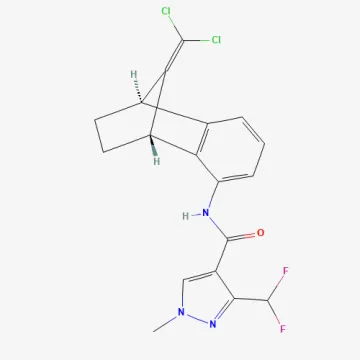
Description
Mode of action
Benzovindiflupyr belongs to the pyrazole-carboxamide chemical class and acts as a potent inhibitor of succinate dehydrogenase (SDHI). It interferes with the mitochondrial complex II, effectively blocking the respiration and energy production of fungal cells.
The substance possesses strong systemic and translaminar properties. Upon application, it rapidly penetrates the plant cuticle and spreads through the leaf tissue, offering consistent protection for both the treated surface and the underlying layers.
Its high lipophilicity is a critical feature, as it binds strongly to the plant's waxy layer. This characteristic ensures excellent rainfastness, allowing the fungicide to remain active even after significant rainfall events following application.
Benzovindiflupyr effectively manages fungal diseases by disrupting spore germination and mycelial growth. It demonstrates both preventive and curative properties, making it a versatile tool for crop protection strategies.
To ensure long-term efficacy and mitigate the risk of resistance development, Benzovindiflupyr is frequently used in mixture with other fungicide classes, such as triazoles, to provide a broader spectrum of activity.
What it targets
This active substance is effective against a broad array of ascomycetes, basidiomycetes, and deuteromycetes. Primary targets include various rusts, leaf spot diseases, septoria, and powdery mildew.
It is widely utilized in cereal production to protect against major foliar diseases. Furthermore, it shows high efficacy in managing complex fungal pressures on soybeans, corn, and diverse vegetable crops.
Benzovindiflupyr is particularly valued for its control over soil-borne pathogens, including Rhizoctonia species, which can cause significant damage to crop root systems and stem bases.
Rates and timing
Application rates are determined by the specific formulation, the target crop, and the disease pressure level. Typical application rates range from 50 to 150 grams of active ingredient per hectare.
Timing is crucial: preventive application during the early stages of infection provides the best results. Depending on the disease pressure, the interval between applications is generally maintained between 14 and 21 days.
Restrictions
To prevent the selection of resistant pathogen strains, it is advised to limit the use of SDHI-class fungicides to a maximum of two applications per growing season on the same field.
Always adhere to the safety guidelines specified on the product label. This includes maintaining appropriate pre-harvest intervals and ensuring safe handling to avoid environmental contamination and operator exposure.
Regulatory
Status in the European Union
Approved in the EU
- CAS number
- 1072957-71-1
- Category (EU)
- FU - Fungicide
- Approved from
- 02.03.2016
- Approval until
- 02.08.2026
- ADI
- 0.05 mg/kg bw/day
- ARfD
- 0.1 mg/kg bw
- AOEL
- 0.04 mg/kg bw/day
Hazard classification (CLP)
Acute Tox. 3 - H301Acute Tox. 3 - H331Aquatic Acute 1 - H400Aquatic Chronic 1 - H410
EU legislation
EU status is for reference only and does not replace national registration in your country.
Reference
Connections · Benzovindiflupyr
Most often together:
Marketplace