
Backup power for a greenhouse: how to calculate capacity and battery reserve
In greenhouse farming, irrigation, fertilizer supply, ventilation, and automation rely entirely on electricity. When power goes out, pumps stop, and controllers lose the ability to manage equipment.
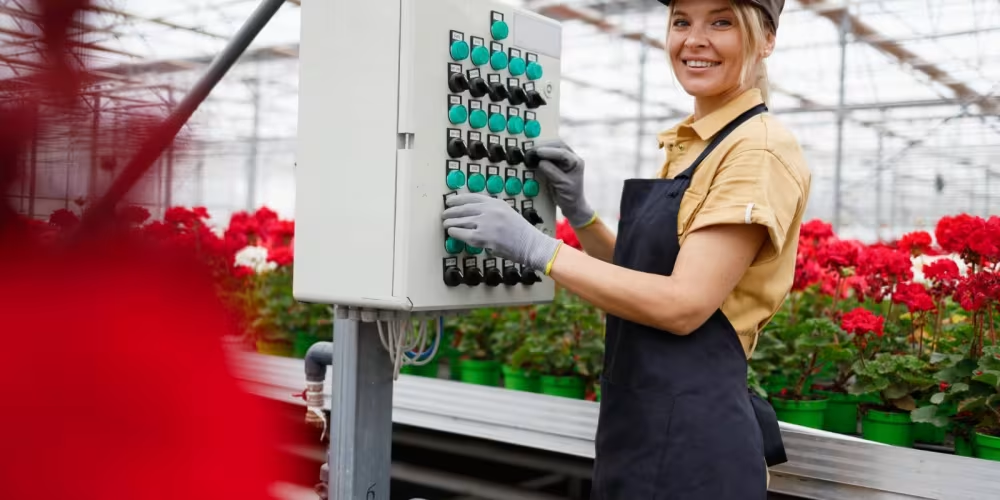
In greenhouse farming, irrigation, fertilizer supply, ventilation, and automation rely entirely on electricity. When power goes out, pumps stop, and controllers lose the ability to manage equipment. The consequences depend on the weather, the crop, and the duration of the outage: a missed irrigation cycle and a stopped ventilation system on a hot day create problems of completely different scales.
To select a backup power supply for a greenhouse, you need to determine the list of necessary equipment, its simultaneous power consumption, and the desired backup runtime. The greenhouse area alone is not enough for such a calculation.
What needs to be connected to the backup power
First, it is worth identifying the equipment whose operation must be maintained during an outage. In a small greenhouse farm, these may include:
water supply pump for the irrigation system;
nutrient solution preparation and dosing unit;
fans and vent actuators;
controllers, sensors, and solenoid valves;
circulation pumps and heating automation;
communication and emergency notification system.
Electric heating and supplemental plant lighting are calculated separately. They can make up the bulk of the load, so connecting them significantly changes the requirements for the backup system.
If the greenhouse is heated by a gas or solid-fuel boiler, the backup can support its automation, pumps, and other electrical components. However, the list of consumers must be checked against the actual heating scheme.
Is a 15 kW backup enough for a greenhouse
A 15 kW system may be suitable for meeting the defined technological needs of a small farm. Let's consider a hypothetical example without electric heaters and supplementary lighting lamps.
Equipment | Simultaneous power consumption |
|---|---|
Irrigation pump | 3 kW |
Ventilation | 2 kW |
Fertigation unit | 0.8 kW |
Circulation pumps | 0.6 kW |
Automation, valves, and communication | 0.3 kW |
Service lighting | 0.3 kW |
Total | 7 kW |
In this example, the 15 kW inverter has a margin in terms of continuous active power. However, the final choice depends on the startup of pumps and fans, load distribution across phases, and the characteristics of the inverter itself.
15 kW is the capacity of the backup source, not the constant consumption of the greenhouse. Equipment may use significantly less, especially when irrigation and ventilation operate intermittently.
The figures provided explain the selection principle. They do not determine the needs of any greenhouse of a specific area.
You can buy a backup power supply for a greenhouse in the online store https://svitlobud.com.ua/nabory-rezervnoho-zhyvlennia/. Before ordering, prepare a list of pumps, fans, and automation, indicate their power and desired backup runtime. These data will help select the inverter and batteries for the needs of your farm.
How to calculate the battery reserve
To determine autonomy, the average consumption during the outage is required. It is more convenient to calculate it through the operation of each device: multiply the power by the number of operating hours, and then add up the results.
For example, if a 3 kW pump operates for one hour, it consumes 3 kWh. If during a four-hour outage it only turns on for 30 minutes, approximately 1.5 kWh is required for its operation.
Suppose measurements show that the average load of critical systems is 4 kW. Then for four hours of autonomy, the equipment requires:
4 kW × 4 h = 16 kWh.
To estimate the nominal battery capacity, you need to account for losses and the available depth of discharge. With a conditional system efficiency of 90% and using 80% of the capacity, the calculation will be as follows:
16 ÷ 0.9 ÷ 0.8 ≈ 22.2 kWh.
Autonomy time | Calculated nominal battery capacity at an average load of 4 kW |
|---|---|
2 hours | approximately 11.1 kWh |
4 hours | approximately 22.2 kWh |
6 hours | approximately 33.3 kWh |
8 hours | approximately 44.4 kWh |
This is a preliminary calculation without an additional margin for battery aging and temperature conditions. Also, batteries must be able to support the required discharge power: capacity in kWh alone does not guarantee this.
Why pump startup must be considered
An electric motor during startup can briefly consume a higher current than during subsequent operation. Because of this, a pump that has enough inverter power in steady-state mode may fail to start from it.
During selection, the motor starting current, startup duration, and the permissible short-term load of the backup source are checked. Three-phase equipment requires a compatible three-phase system. Single-phase consumers are also distributed taking into account the limitations of each phase.
The features of motor startup and the priority of load connection are also taken into account when choosing a generator.
How to prepare the farm for prolonged outages
If the battery reserve is only enough for part of a potential outage, the system can be supplemented with a generator. In such a scheme, batteries provide power to designated consumers, while the generator maintains further operation and, if provided by the equipment, charges the batteries.
It is also necessary to check the charge recovery speed. A large battery will not help survive multiple consecutive outages if the system does not have time to replenish the spent energy between them.
Before purchasing equipment, it is worth recording the actual consumption of the greenhouse in various modes: during irrigation, ventilation, and heating. This will allow you to select the inverter power and battery capacity according to the farm's needs. After installation, it is necessary to test switching to backup and starting all critical devices under a real load.
Editorial team agronom.info
Materials are prepared by the portal's agronomists and editors. We use only trusted sources: Ukrainian agricultural universities, variety registries, open scientific publications.
Related articles
Not yet comments. Be the first!
Comments