
Banded thrips
Aeolothrips fasciatus
Description
How to identify
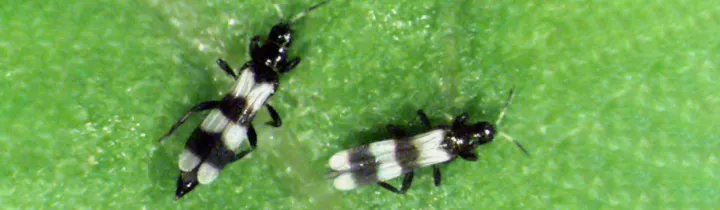
The banded thrips (Aeolothrips fasciatus) is a member of the Aeolothripidae family within the Thysanoptera order. This species is unique because it exhibits both predatory and phytophagous feeding habits.
Adult specimens measure approximately 1.5 to 2 mm in length. The most distinct characteristic is the presence of dark transverse bands on their wings, which provides the common name.
Their body coloration typically ranges from dark brown to black, allowing them to remain hidden on the surface of host plants during the day while feeding or resting.
The life cycle encompasses several distinct stages: egg, larva, prepupa, pupa, and adult. Each stage of development is highly sensitive to environmental factors like temperature and humidity.
These insects are highly adaptable and thrive in various climates, making them a recurring concern in diverse agricultural and horticultural systems across different regions.
What it damages
While often predatory, Aeolothrips fasciatus can cause significant damage to crops including cereals, legumes, various vegetables, and ornamental garden plants.
They damage plant tissues by piercing the epidermis and sucking out the sap. This process leads to reduced chlorophyll levels and significant physiological stress for the plant.
Heavy infestations typically result in reduced crop yield, stunted plant growth, and a marked decline in the quality and marketable value of fresh vegetables and fruits.
Beyond direct feeding damage, they act as vectors for various plant viruses, spreading infections throughout a field much faster than environmental factors alone.
Ornamental flowers are particularly susceptible to deformation and petal discoloration, which can render entire crops unsuitable for commercial distribution or retail sale.
Signs of infestation
Initial signs of a banded thrips infestation often include small, light-colored stippling or silvery streaks appearing on the surface of leaves as cells lose their content.
The presence of minute, dark fecal spots left behind by the insects on leaves and petals is a classic indicator that a colony is active and feeding in the area.
As the population grows, leaves may become distorted, curled, or scorched, while severely damaged areas can turn necrotic, leading to leaf drop or plant death.
Flowers and buds frequently show signs of malformation, delayed opening, or premature abscission, indicating that thrips have been feeding within the developing tissues.
Observing a sudden decline in plant health, coupled with the presence of slender, active insects when shaking foliage over a white card, confirms their active presence.
Control measures
Successful management of the banded thrips requires an integrated approach that focuses on prevention, population monitoring, and targeted intervention strategies.
Sanitation practices, such as the consistent removal of weeds and debris in and around the field, are essential to eliminate overwintering sites for the pest population.
Monitoring using sticky traps, particularly blue or yellow ones, is a critical tool for detecting early arrivals and determining the precise timing for control actions.
Encouraging or releasing beneficial insects, such as lacewings and predatory bugs, serves as a sustainable way to suppress thrips populations naturally without chemical inputs.
When populations exceed economic thresholds, applying systemic insecticides is necessary; however, always rotate chemical groups to prevent the development of pesticide resistance.
Taxonomy
- Latin name
- Aeolothrips fasciatus
- Order
- Thrips
- Family
- Aeolothripidae
- EPPO code
- AEOOFA
Discussion
No discussions yet — be the first.