
Aeolothrips
Aeolothrips
Description
How to identify
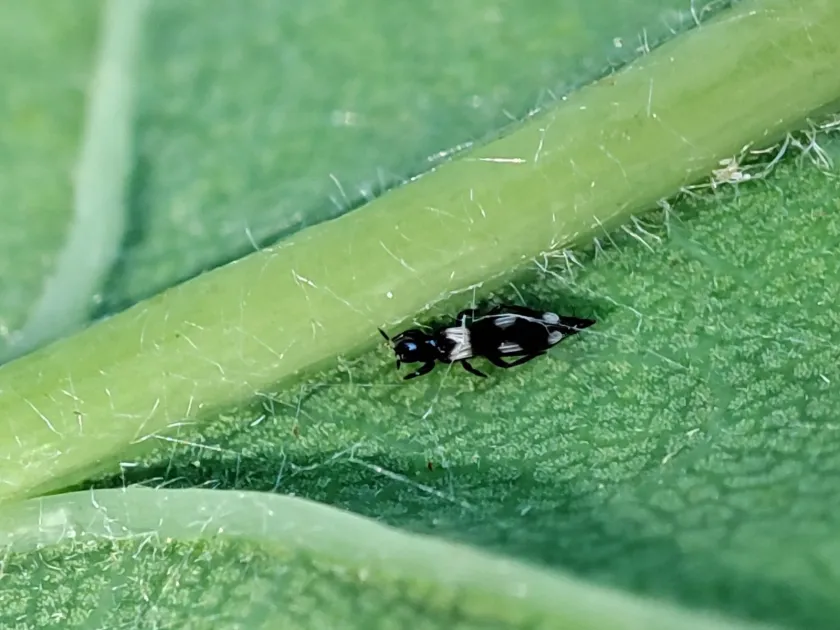
Aeolothrips belongs to the family Aeolothripidae, within the suborder Tubulifera. These insects are small in size, typically characterized by dark bodies and distinct light-colored bands on their wings.
Unlike many other members of the Thysanoptera order, Aeolothrips have a more robust body structure and unique wing venation that allows specialists to accurately identify the genus through microscopic analysis.
The biology of these insects involves stages of egg, larva, prepupa, pupa, and adult. The adults are highly mobile and capable of flight over significant distances in search of food sources.
It is important to note that among the species of this genus, there are both herbivores and predators that feed on other small pests, such as spider mites or the larvae of other thrips.
For accurate identification in the field, agronomists utilize sweep nets and visual inspection methods of inflorescences, where these insects prefer to congregate.
What it damages
Aeolothrips species damage a wide range of agricultural crops, including cereals, legumes, as well as many vegetable and ornamental plants.
The greatest damage is caused by both adults and larvae, which pierce the epidermis of young leaves, stems, and flowers, sucking the cell sap from the plant tissues.
Damaged tissue areas lose turgor, gradually yellow, deform, and eventually die, which significantly reduces the total photosynthetic surface area of the plant.
The danger is particularly high when reproductive organs like inflorescences, ovaries, and anthers are damaged, leading to partial or total flower sterility and a sharp drop in yields.
Secondary fungal and bacterial infections often develop at the puncture sites, as the compromised tissue integrity makes it easier for pathogens to enter the plant.
When it appears
The mass emergence of Aeolothrips is usually timed to the period of active plant growth, starting from late spring and continuing through mid-summer.
The most favorable conditions for reproduction and population growth are dry and hot weather, which accelerate the life cycle of the pest.
Throughout the season, several generations can develop under optimal temperatures, leading to a wave-like increase in the number of insects in the field.
In autumn, adults migrate into the soil or plant debris for overwintering, which is why thorough field sanitation after harvest is crucial for reducing the wintering population.
Monitoring for population density should begin at the jointing or budding stage, as this is when the pest begins to actively colonize crops.
Signs of infestation
A typical sign of Aeolothrips presence is the appearance of silvery or light streaked spots on leaves, which eventually merge into discolored areas.
When inspecting inflorescences, one can detect characteristic "black" dots (insect excrement), which indicate a high density of the pest.
Deformation of young shoots and curling of leaves are other clear symptoms pointing to the systematic sucking of plant juices by the thrips population.
Shaking the affected ear over a white sheet of paper makes it easy to spot moving individuals, serving as a reliable method for field diagnostics.
Premature petal shedding and empty grains in ears are late signs of damage that indicate a critical level of infestation.
Control measures
Agronomic control methods include implementing crop rotation, eliminating weed hosts that serve as pest reservoirs, and performing deep fall plowing.
Chemical control methods are effective during periods of mass infestation when the number of individuals per plant exceeds the economic threshold of damage.
For crop protection, systemic insecticides are applied as they penetrate plant tissues and target concealed pests effectively.
- Using selective insecticides to preserve beneficial entomophages.
- Strict adherence to pesticide application regulations.
- Deployment of yellow sticky traps for population monitoring.
Biological control involves the use of natural enemies of thrips, such as predatory Orius bugs or lacewings, which can significantly reduce population density.
Taxonomy
- Latin name
- Aeolothrips
- Order
- Thrips
- Family
- Aeolothripidae
- EPPO code
- AEOOSP
Discussion
No discussions yet — be the first.