
Tetranychina
Tetranychina
The genus Tetranychina belongs to the Tetranychidae family, commonly known as spider mites. These are microscopic arachnids that are difficult to detect during the early stages of colonization.
What the section contains
Tetranychina
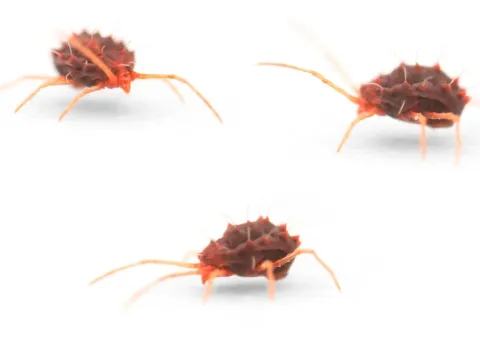
Adult mites are oval-shaped and range in color from pale green to deep red or brown, depending on their diet and developmental stage. They possess specialized mouthparts used to pierce plant tissue.
Their life cycle consists of the egg, larva, protonymph, deutonymph, and adult stages. The time taken to reach maturity is highly dependent on ambient temperature and relative humidity.
Populations can increase exponentially under hot and dry conditions, allowing them to rapidly colonize entire fields or greenhouse production areas.
Overwintering typically occurs as diapausing females sheltered within plant debris, soil crevices, or protected areas near host plants.
These mites infest a broad range of crops, including vegetables, fruits, and ornamental plants, by feeding on the cellular contents of leaf tissues.
By rupturing individual plant cells, they cause localized chlorosis, which manifests as small white or yellowish stippling across the leaf surface.
As the infestation progresses, these stippled areas coalesce, leading to severe leaf bronzing, wilting, and eventually premature defoliation of the entire plant.
The reduction in photosynthetic capacity severely impacts the plant's metabolism, resulting in stunted growth and significant losses in yield and quality.
Weakened plants also become significantly more susceptible to opportunistic secondary infections, such as fungal pathogens or insect-borne viruses.
Activity usually begins in the spring as temperatures rise above 15°C. Development speeds up significantly with the onset of warmer spring and summer days.
Peak population pressure is generally observed during the mid-summer months when dry, hot weather minimizes natural fungal mortality and promotes rapid breeding cycles.
As day length shortens and autumn temperatures drop, the population enters a diapause phase to survive the winter, effectively ending the active feeding season.
In indoor environments or glasshouses, Tetranychina can maintain continuous breeding cycles throughout the year if temperature and humidity remain constant.
Dry periods are the primary driver of mite outbreaks, as high humidity and rainfall naturally suppress the expansion of mite colonies on host crops.
Early symptoms include the appearance of tiny, light-colored dots on the lower leaf surface, which gradually become visible as stippling on the upper side.
Heavily infested leaves turn a dull grey or bronze color, lose their rigidity, and begin to curl or dry out as they lose their internal water balance.
Using a magnifying glass, one can identify the mites themselves, their discarded skins, and small spherical eggs located near the leaf veins.
Visual inspection of plant health often reveals poor growth, stunted development of fruit, and a general loss of vigor throughout the canopy.
While some related species produce heavy webbing, Tetranychina often produces less noticeable silk, requiring careful scouting to detect the presence of the pest.
Cultural control methods are essential and include the rigorous removal of weeds, which act as alternate hosts, and proper sanitation of crop residues after harvest.
Maintaining adequate irrigation and preventing plant moisture stress can significantly reduce the attractiveness of the environment to spider mites.
Chemical control with acaricides is often necessary for high-density infestations, ensuring rotation between different modes of action to prevent resistance.
- Biological control using predatory mites such as Phytoseiulus species.
- Consistent scouting and monitoring using traps and field observations.
- Implementation of crop rotation and distance barriers between susceptible fields.
Application of pesticides must ensure thorough coverage, especially targeting the undersides of leaves where these mites prefer to live and feed.