
Cabbage moth
Phytometra brassicae
Description
How to identify
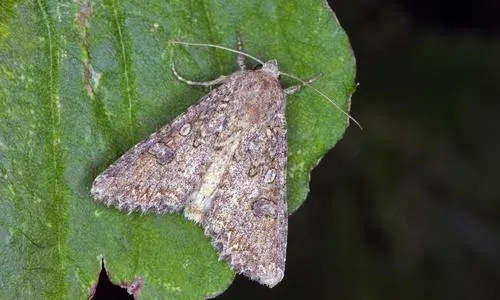
The Cabbage moth (Latin: Mamestra brassicae) belongs to the family Noctuidae within the order Lepidoptera. Adult moths have a wingspan of about 40–50 mm, with mottled brownish-gray forewings featuring distinctive patterns and marks.
The larvae, or caterpillars, change significantly in appearance as they mature. Early instars are light green, while later stages become darker, often showing a brownish or olive-green color with characteristic triangle-shaped markings on the dorsal side.
The pupal stage occurs in the soil at a depth of up to 10 cm. The pupae are dark brown, glossy, and serve as the overwintering life stage for the pest in agricultural fields.
Adult moths are nocturnal, feeding primarily on nectar. Because they are active at night and hide during the day, their presence is often overlooked until the damage to plants becomes significant.
Eggs are laid in clusters, usually on the underside of leaves. They are spherical, initially light-colored, and transition to a darker tone just before the larvae hatch.
What it damages
The primary host plants are members of the Brassicaceae family, including all types of cabbage, broccoli, cauliflower, Brussels sprouts, and kale.
This pest is highly polyphagous, meaning it can also infest other crops such as tomatoes, beets, lettuce, onions, and legumes when primary hosts are unavailable or populations are high.
Young larvae feed on the epidermis and soft leaf tissue, creating small "windows" or translucent patches. As they grow, they consume entire leaf sections, leaving only large, irregular holes.
The most severe damage occurs when larvae bore into the heads of cabbage. Their feeding creates tunnels that destroy the core of the vegetable and introduce pathogens that lead to secondary rot.
Infested produce loses market value entirely, becomes unsuitable for long-term storage, and poses health risks due to fecal contamination within the vegetable.
When it appears
The first generation of moths typically emerges in late May or early June, coinciding with the rapid vegetative growth period of most vegetable crops.
Oviposition is staggered, meaning that larvae of different developmental stages can be found simultaneously on plants throughout the summer months.
A second generation often develops in late summer. This generation is particularly destructive to late-season cabbage varieties that are in the process of forming heads.
Optimal conditions for larval development—warm temperatures and sufficient moisture—make July and August the peak period for infestation and crop destruction.
As autumn temperatures drop, the final larval instars descend into the soil to pupate, where they remain dormant throughout the winter until the next spring.
Signs of infestation
The earliest signs of infestation are ragged, irregular holes in the leaves and the presence of dark pellet-like frass on the leaf surfaces.
Careful inspection of the undersides of leaves will reveal clusters of eggs, which appear as yellowish or light-brown patches, often arranged in neat patterns.
Wilting of individual leaves or dark, sunken spots on the cabbage head are clear indicators that larvae have entered the plant and are feeding internally.
Observing nocturnal moths flying around the garden during dusk is a strong indicator of egg-laying activity and a need to monitor the crop closely.
In cases of severe infestation, the presence of secondary rot and an unpleasant odor near the damaged areas indicates that the pest has been active for an extended period.
Control measures
Cultural control practices include deep autumn tilling of the soil, which exposes overwintering pupae to predators and adverse weather conditions, significantly reducing the population.
Rigorous weed management, especially targeting wild Brassicaceae species, removes alternative food sources and breeding grounds for the pest during the season.
Biological control involves the use of parasitic wasps (e.g., Trichogramma) or microbial insecticides based on Bacillus thuringiensis, which are effective against young larvae.
Chemical control using systemic or contact insecticides may be necessary during outbreak years, provided that strict harvest intervals are followed to ensure consumer safety.
Manual collection of egg clusters and larvae is a labor-intensive but highly effective method for small-scale gardens to maintain control without resorting to synthetic pesticides.
Discussion
No discussions yet — be the first.