
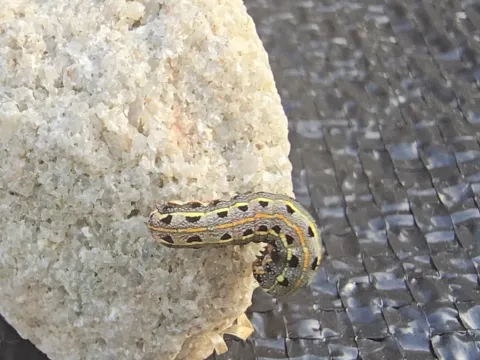
Cotton bollworm
Prodenia
The cotton bollworm (Helicoverpa armigera) is a highly destructive pest belonging to the Noctuidae family. Adult moths have a wingspan of 35–40 mm and possess a light brown or yellowish-grey color with dark markings on the wings.
What the section contains
Cotton bollworm
The larvae, or caterpillars, undergo six instars, growing up to 45 mm in length. Their color is highly variable, ranging from pale green to dark brown or black, often with distinct longitudinal stripes along the body.
The pest overwinters as a pupa in the soil at a depth of 4–15 cm. Adult moths emerge in the spring once soil temperatures reach levels conducive to their biological development, typically above 18°C.
Female moths are extremely prolific, laying up to 3,000 eggs individually on host plants. These eggs are usually placed on soft tissues like young leaves, buds, or flowers, which provide immediate food for hatching larvae.
Given its ability to migrate over long distances and its rapid reproductive rate, the cotton bollworm remains one of the most monitored insects in global agricultural production.
As a polyphagous species, the cotton bollworm infests over 120 types of plants. It is a major threat to cotton, tomatoes, corn, sunflower, soybean, and various leguminous crops, causing significant yield losses worldwide.
Early instar larvae feed on leaves, but the most severe damage occurs as they mature. They bore into reproductive organs, such as cotton bolls, tomato fruits, and corn ears, effectively destroying the plant’s ability to produce a marketable crop.
Feeding inside the fruit leads to both direct tissue destruction and the introduction of secondary pathogens like fungi and bacteria, which cause the fruit to rot or shrivel prematurely.
In corn, larvae feed on the developing kernels at the tip of the ear, often tunneling through the husks. This feeding behavior protects the larvae from contact insecticides, making control significantly more difficult.
The economic impact is profound, as the destruction of buds and flowers prevents the formation of fruits, leading to sparse development and drastic reductions in the total harvest mass.
The pest's activity begins in late spring or early summer. Depending on the climate, the cotton bollworm can complete multiple generations per season, often overlapping, which leads to a constant presence of larvae in the field.
The peak periods of infestation usually coincide with the flowering and fruit-setting stages of the host crops. This is when the plant's nutritional value is highest, attracting the egg-laying moths.
Summer heat typically accelerates the life cycle, leading to rapid increases in population density. If irrigation is present, the cotton bollworm can survive and thrive even in arid regions by exploiting the lush crop canopy.
As autumn approaches, the final generation of larvae pupates in the soil, entering a stage of diapause to survive the winter. Their ability to remain dormant underground makes them resilient to varying winter temperatures.
Scouting and monitoring using pheromone traps are essential for predicting the timing of larval outbreaks, as it allows growers to prepare control measures before the larvae reach the destructive later instars.
The first signs are small, irregular feeding windows or holes on the leaves caused by young larvae. These are often overlooked until the population density increases and more severe damage becomes apparent.
One of the most obvious signs is the shedding of buds and blossoms. When plants begin to lose their reproductive organs prematurely without obvious mechanical reason, the presence of the bollworm is likely.
Holes in fruits (such as tomatoes or cotton bolls) are diagnostic signs. These entry holes are frequently accompanied by frass (larval excrement), which accumulates around the entrance site.
Wilting of the upper foliage or specific parts of the plant can indicate that the larva has bored into the stem or fruit base, disrupting the nutrient supply to the rest of the plant.
- Presence of light-colored eggs on the underside of leaves or flower stalks.
- Skeletonized leaf patches.
- Excrement accumulation on leaves or fruit surfaces.
- Entry holes in fruits and bolls.
- Premature drop of buds and flowers.
Cultural control practices, such as deep autumn plowing, are highly effective as they bring pupae to the surface, exposing them to predators and harsh winter weather, thereby reducing the population for the following year.
Biological control methods include the release of parasitic wasps like Trichogramma, which target the eggs of the moth. This method is environmentally friendly and highly successful when timed with egg-laying peaks.
Chemical control is often necessary and should be applied when larvae are in the first or second instar, as they are most vulnerable at this stage and have not yet bored into the protected fruit tissues.
Implementing an Integrated Pest Management (IPM) program is crucial. This involves alternating insecticides with different modes of action to prevent the development of resistance, which is a common issue with this species.
Using pheromone traps and regular field inspections ensures that control measures are triggered only when necessary, minimizing costs and reducing the impact on beneficial insect populations in the field.