
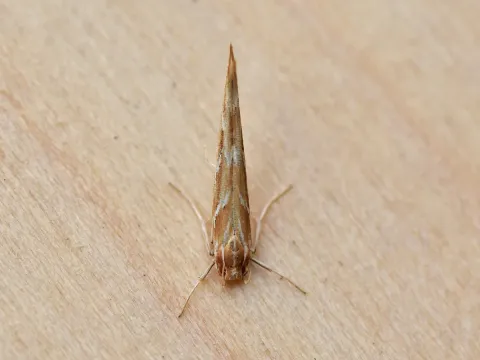
Cotton seed moth
Pyroderces coriacella
The cotton seed moth (Pyroderces coriacella) belongs to the Cosmopterigidae family of moths within the order Lepidoptera. This species is recognized as a significant pest of cotton and various stored seed products, particularly in warmer climates.
What the section contains
Cotton seed moth
The adult moth is small with narrow, fringed wings, which is a common characteristic of the family. The coloration is typically ochreous to brown, allowing it to camouflage effectively against plant surfaces or debris in storage facilities.
The life cycle encompasses four stages: egg, larva, pupa, and adult. The larval stage is the most destructive, as the caterpillars consume the internal contents of seeds and fruit tissues to fuel their growth.
The species thrives in arid and high-temperature environments, facilitating rapid population growth and multiple generations per year. This makes it a persistent challenge in both field crops and storage silos.
Accurate identification is crucial for effective management. Specialists often rely on microscopic examination of adult genitalia or the specific symptoms of larval feeding to differentiate it from other related micro-lepidoptera.
Larval feeding is the primary cause of damage, as the insects tunnel into the reproductive organs of host plants. In cotton, they feed directly on the fiber and seeds inside the boll, causing irreversible quality loss.
Stored agricultural products, especially legumes and various grains, are heavily susceptible to infestation. The larvae consume the embryo and endosperm of the seeds, rendering them useless for both consumption and planting.
The presence of larvae also leads to secondary contamination. The debris and frass left behind provide a substrate for various fungi and molds, which can spread throughout a grain mass and trigger large-scale spoilage.
In addition to weight loss, the economic impact includes reduced market value, increased costs for cleaning, and the risk of entire shipments being rejected during international phytosanitary inspections.
Large populations can compromise the integrity of seed storage, as the damaged seeds lose their germination potential, leading to crop failure if such seeds are used for sowing the following season.
One of the earliest signs in the field is the appearance of small holes in cotton bolls, often accompanied by silk webbing. Affected bolls may dry out or fail to open properly, revealing discolored and damaged fibers inside.
In warehouses, a common sign is the accumulation of powdery dust (insect excreta and chewed seed particles) at the base of containers. This "milling" effect is a clear indicator that larval feeding is underway.
Close inspection of individual seeds often reveals small exit holes where the moths have emerged. The seeds may look dull or be clumped together due to the fine webbing spun by the larvae.
An unusual rise in temperature within a grain heap is a critical diagnostic sign, suggesting that the infestation is causing fermentation or self-heating of the product. This requires immediate intervention.
Monitoring using pheromone traps or light traps can detect the presence of adult moths, serving as an early warning system for farmers and storage facility managers to initiate control measures.
Integrated Pest Management (IPM) is essential for controlling Pyroderces coriacella. Strict phytosanitary protocols must be enforced during the transport of seed materials to prevent the spread of the moth into new areas.
Chemical control in the field should be timed with the peak of adult egg-laying activity. In storage facilities, fumigation is the most common and effective method to eradicate existing populations, provided the silos are properly sealed.
Cultural practices include the thorough cleaning of harvest remnants from the field, which serve as overwintering sites for the pest. Rapid post-harvest processing and cooling of grain can significantly reduce the viability of eggs and larvae.
Biological control, such as the release of parasitoid wasps (e.g., Trichogramma), can be employed in integrated systems to manage larval populations naturally, reducing the reliance on broad-spectrum pesticides.
- Use of airtight storage containers for seed stock.
- Regular inspection of crops during the ripening phase.
- Deep plowing to bury infested crop residues.
- Maintaining low moisture content in stored grains.
- Implementation of rotation schemes to interrupt the pest life cycle.