
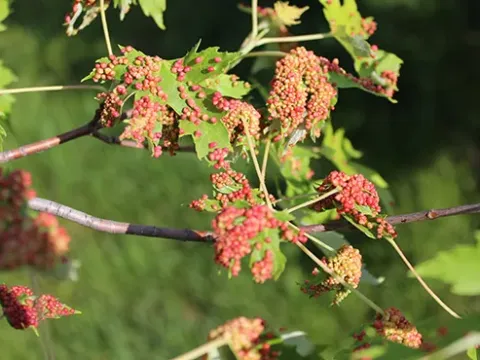
Maple gall mite
Phytoptus aceris
The maple gall mite (Phytoptus aceris) belongs to the Eriophyidae family, known as four-legged mites. These are microscopic arachnids with elongated, worm-like, pale bodies, measuring only 0.2 to 0.3 mm in length, making them invisible to the naked eye.
What the section contains
Maple gall mite
These mites possess only two pairs of legs located at the front of their bodies. They do not spin webs like spider mites; instead, they are strictly associated with the formation of galls — abnormal tissue growths — on the leaves of their host plant.
Adult mated females overwinter in the crevices of bark, under bud scales, or in the axils of buds. When spring temperatures rise and buds begin to swell, they emerge and migrate onto the developing leaves.
Their life cycle is closely synchronized with the phenology of the maple tree. Several generations can be produced within a single growing season, allowing for rapid colonization of the canopy if conditions are favorable.
Dispersal between trees occurs primarily through wind currents, though they can also be transported by insects, birds, or humans moving infested nursery stock.
The primary hosts for Phytoptus aceris are maple trees (genus Acer), with Norway maple being a particularly common target. They are highly specialized pests that rarely infest non-maple species.
Damage is caused by the mite's feeding activity and the injection of saliva, which induces the host plant to produce galls. These galls serve as both a shelter and a food source for the mite colony throughout the season.
While a single tree can support a large population of mites without dying, the cumulative effect of constant feeding causes significant physiological stress. This reduces the tree's overall vigor and photosynthetic efficiency.
In nursery settings, heavy infestations can cause leaf curl and premature leaf drop, leading to stunted growth and reduced aesthetic value, which directly impacts the commercial viability of the stock.
In urban landscapes, infested maples may look unsightly during mid-summer, potentially leading to increased susceptibility to secondary pests or pathogens that exploit the weakened state of the tree.
Activity begins in early spring, synchronized with bud break. As soon as the green tips of the buds appear, the overwintering mites move to the fresh, succulent leaf tissue to begin feeding.
The most intensive gall formation occurs during late spring and early summer. During this period, the mites multiply rapidly within the newly formed structures, protected from both predators and environmental conditions.
By mid-summer, the population density often reaches its maximum. The leaves become heavily textured with various galls, and the damage becomes highly visible to any observer.
In late summer or early autumn, as leaf quality declines, the mites begin to exit the galls. They migrate toward the twigs, searching for suitable overwintering sites in bark crevices or near bud scales.
Environmental factors, specifically long, warm, and dry springs, are known to promote higher rates of mite development and survival compared to cold, wet seasons.
The most diagnostic sign of an infestation is the presence of galls on the leaves. These appear as small, wart-like, or pimple-like bumps that may be concentrated on either the upper or lower surface of the leaf.
- Leaf deformation: Affected leaves may become severely curled, stunted, or crinkled, losing their natural, flat, palmate shape.
- Discoloration: Galls often appear in vibrant shades of red, pink, or yellow, later turning brown as the season progresses.
- Premature browning: In severe cases, the entire leaf may yellow and drop prematurely by mid-summer.
- Surface texture changes: The leaves become rough and leathery to the touch due to the dense population of galls.
Although the galls themselves are not fatal to the tree, they significantly reduce the photosynthetic surface area. A heavily infested canopy can look sparse and discolored by late July.
Using a hand lens, one can sometimes see the tiny mites or their cast-off skins if a fresh gall is carefully opened during the growing season.
Controlling the maple gall mite is challenging because the mites are protected inside the galls for the majority of the season, making them immune to contact insecticides.
- Sanitation: Pruning and destroying heavily infested branches during the dormant season can help reduce the population for the following year.
- Chemical timing: The most effective window for control is at the "green tip" stage in early spring, just as overwintering mites emerge to feed.
- Acaricides: Targeted applications of sulfur-based or systemic acaricides can be effective if applied before the galls fully enclose the mites.
- Plant health: Maintaining good hydration and soil fertility helps the tree tolerate mite damage and recover more effectively.
- Natural enemies: Encourage beneficial insects like predatory mites, lacewings, and lady beetles, which help keep populations in check.
Pesticide rotations are advised if multiple applications are necessary, ensuring that different chemical classes are used to minimize the risk of the mites developing resistance.