
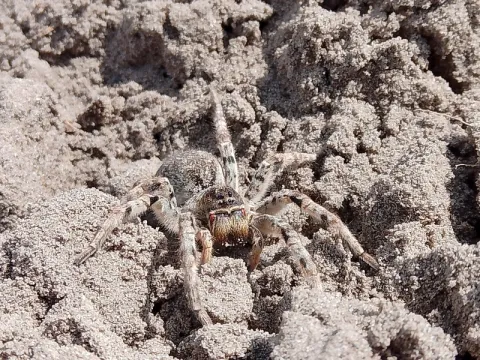
South Russian tarantula
Lycosa singoriensis
The South Russian tarantula (Lycosa singoriensis) belongs to the family Lycosidae, commonly known as wolf spiders. It is one of the largest spider species found in its range.
What the section contains
South Russian tarantula
The body is robust and densely covered in hair, typically displaying shades of brown, gray, or reddish-tan, which provides camouflage in their native environment.
Females are significantly larger than males, with body lengths up to 35 mm. They possess excellent eyesight to detect prey during their nocturnal hunting activities.
They are known for their maternal care, as females carry their egg sacs attached to their spinnerets and subsequently carry the spiderlings on their backs.
The species lives in deep, vertical burrows that serve as shelter from extreme temperatures and predators, reaching depths of up to half a meter.
The South Russian tarantula is not a phytophagous species and does not consume plant tissues directly, thus it causes no direct damage to crops.
The main concern regarding this species in agriculture is its role as a predator that may consume beneficial insects, including pollinators and entomophages.
In large numbers, their burrowing activity can disrupt soil structure, which may interfere with mechanical sowing or cultivation procedures in certain soil types.
The disruption of the natural balance of predator-prey relationships in fields can sometimes lead to outbreaks of actual agricultural pests.
While not a primary pest, their presence in high concentrations is often seen as a sign of an unbalanced ecosystem that may require management.
The activity cycle of the tarantula begins in early spring, as temperatures rise and the soil begins to warm up significantly.
The peak period of activity is during the summer months, when they emerge at night to actively hunt and reproduce across fields and meadows.
As autumn progresses and nighttime temperatures drop, their metabolic rate decreases, prompting them to retreat into their burrows for overwintering.
Winter is spent in a state of diapause at the bottom of their deep burrows, safe from frost and sudden temperature fluctuations.
The lifecycle from egg to adult is a multi-year process, heavily dependent on the availability of prey and favorable weather conditions during the warm season.
The most reliable sign of a local population is the presence of deep, cylindrical holes in the ground, usually located away from heavy traffic areas.
The edges of the burrows are often lined with a thin layer of silk and soil, forming a small collar or barrier that keeps debris from falling inside.
On warm summer nights, individuals can be spotted at the entrance to their burrows, as they sit and wait for passing insects, reflecting light from their eyes.
Clusters of holes in fallow land or on the edges of agricultural plots are strong indicators of a stable breeding population.
Disturbed patches of soil near these burrows suggest active maintenance or foraging, especially after rain or irrigation events.
Deep plowing of the soil is the most effective mechanical method for destroying the burrows and exposing the spiders, leading to their relocation or death.
Maintaining clean agricultural plots and removing excessive weeds reduces the availability of cover and prey for the spiders.
Encouraging natural predators such as birds and larger predatory insects can help keep spider populations within manageable limits.
Chemical intervention is rarely required and is discouraged to prevent harm to beneficial insect populations within the field.
- Deep soil cultivation.
- Integrated pest management strategies.
- Biological control through natural predators.