
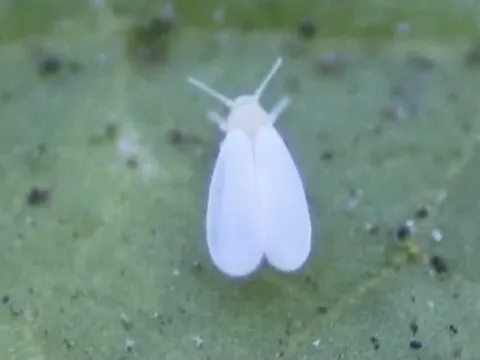
Sow thistle whitefly
Trialeurodes sonchi
Sow thistle whitefly (Trialeurodes sonchi) is a member of the order Hemiptera and the family Aleyrodidae. These are tiny insects, typically measuring 1 to 1.5 mm, covered with a white waxy powder that gives them their characteristic appearance.
What the section contains
Sow thistle whitefly
Adults resemble minute moths with two pairs of wings. The species identification often requires microscopic examination of the pupal case, as morphological features are specific to this particular whitefly species.
The life cycle consists of the egg stage, three larval instars, the pupal stage, and the adult stage. Eggs are usually deposited on the underside of leaves and are secured by a small pedicel to ensure stable attachment to the plant tissue.
Early-stage larvae are mobile, allowing them to move to suitable feeding sites on the leaf. Subsequent larval stages are sessile, attaching themselves firmly to the plant and becoming increasingly difficult to distinguish from the leaf surface.
Field identification involves careful inspection of the leaf undersides, particularly near veins, where colonies of all developmental stages are typically found in protected and nutrient-rich environments.
While the primary host is the sow thistle (Sonchus), this pest frequently infests agricultural crops, including tomatoes, cucumbers, peppers, and various leafy greens, particularly in open-field conditions.
The pest causes significant damage by extracting sap from the phloem, which leads to plant exhaustion, stunted growth, and a reduction in the quality and quantity of the harvest.
Whiteflies produce honeydew, a sticky substance that coats the leaves. This serves as a primary substrate for the growth of sooty mold, which effectively blocks sunlight and impairs the photosynthetic ability of the plant.
Trialeurodes sonchi is also a potential vector for several plant-pathogenic viruses. Even low infestations can lead to widespread viral outbreaks within a field, causing systemic damage that is often irreversible.
Severe infestations result in yellowing and premature dropping of leaves, leading to the overall collapse of the plant's health and significant economic losses for commercial growers.
The activity of the sow thistle whitefly typically begins in late spring, as temperatures consistently rise above the threshold required for successful development and egg hatching.
The pest is capable of completing multiple generations during a single growing season. Higher temperatures accelerate the development rate, leading to rapid population surges in the mid-summer months.
Peak populations are usually recorded during the late summer, coinciding with the maturation of many vegetable crops, which provide optimal feeding conditions for the whitefly colonies.
As autumn temperatures drop, the whiteflies seek overwintering sites. They often remain on perennial weeds or crop residues in the pupal stage, awaiting the return of favorable conditions in the following year.
Monitoring programs use yellow sticky traps placed near the canopy to track population trends and determine the optimal timing for intervention before the pest reaches destructive levels.
The most obvious sign of an infestation is the appearance of small, white clouds of insects that take flight when the plant is disturbed or shaken.
A closer look at the underside of the leaves reveals clusters of small, scale-like structures, which are the larval stages of the pest feeding on the plant's vascular system.
The presence of sticky honeydew on the foliage, often followed by the development of black sooty mold, is a clear indicator that a large whitefly population is currently established.
Yellowing, curling, and chlorosis of the leaves are common symptoms of severe sap depletion and stress caused by the feeding activities of thousands of individual insects.
Stunted plant growth and a visible decrease in fruit yield are late-stage signs of high infestation, indicating that the plant's resources have been severely depleted by the pest.
Integrated pest management (IPM) for this species begins with rigorous weed control, specifically targeting sow thistles in and around the field to eliminate the pest's primary reservoir.
- Use of biological control agents, such as parasitoid wasps or predatory bugs, to suppress population levels naturally.
- Systemic insecticide applications during peak activity periods to provide long-term protection.
- Rotation of chemical classes to prevent the development of resistance in whitefly populations.
- Maintaining physical barriers like insect-proof netting in sensitive crops or greenhouse environments.
- Post-harvest management, including the destruction of crop residues to eliminate overwintering sites.
Insecticide timing is critical; applications must be synchronized with the most susceptible life stages of the pest while respecting pre-harvest intervals for food crops.
Field margins should be closely monitored and maintained, as these areas often serve as the bridge for whitefly migration from weeds into the main cultivated crop zones.
By combining habitat management, monitoring, and precise intervention strategies, growers can maintain whitefly populations below the economic threshold and protect their crops.