
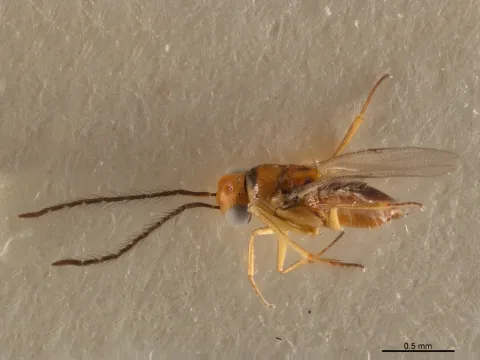
Leptomastix longipennis
Leptomastix longipennis
Leptomastix longipennis is a specialized parasitoid wasp belonging to the Encyrtidae family within the order Hymenoptera. It is a highly mobile insect characterized by well-developed wings and a metallic appearance.
What the section contains
Leptomastix longipennis
Adults possess distinctive morphological features typical of encyrtids, including long antennae and an active searching behavior. Females are equipped with an ovipositor designed to penetrate the host's body efficiently.
The species primarily targets the citrus mealybug, Planococcus citri. The wasp uses complex olfactory cues to detect its host on various plant surfaces, including leaves and twigs.
The life cycle of the parasite is tightly linked to the density of the mealybug population. In optimal conditions, the wasp completes its development rapidly, allowing for an efficient response to pest outbreaks.
As a specialized parasitoid, this insect plays a crucial role in the natural regulation of pest populations, particularly in citrus-growing regions globally.
It is important to clarify that Leptomastix longipennis is not a plant pest; rather, it is a highly beneficial parasitoid that aids in crop protection by consuming harmful insects.
The primary crops benefiting from the presence of this insect include citrus trees such as lemons, oranges, and tangerines. Without this natural enemy, mealybug infestations can cause significant economic losses.
The mealybug, a pest targeted by this wasp, causes plant decline by sucking sap, which leads to leaf yellowing, shoot deformation, and the growth of sooty mold due to honeydew excretion.
The wasp's impact involves parasitizing the mealybug larvae. The parasite larva feeds internally on the host, ultimately killing it and effectively preventing the pest from reproducing further.
By effectively managing mealybug populations, Leptomastix longipennis reduces the need for frequent chemical pesticide applications, thereby promoting a more balanced ecosystem in orchards.
The most reliable sign of the parasitoid's activity is the presence of "mummified" mealybugs. Once the adult wasp emerges, a small, circular exit hole remains on the shell of the dead host.
A noticeable decline in active mealybug colonies, in the absence of insecticide treatment, strongly suggests that the population is being suppressed by this beneficial parasitoid.
Adult wasps can be observed by carefully inspecting the foliage during sunny hours. They move actively across the plant surface, searching for hosts to parasitize.
During warmer months, the signs of parasitism become more prevalent due to the increased metabolic rate of the insects and the accelerated development of subsequent wasp generations.
Parasitized colonies differ visually from healthy ones, appearing as dark, rigid, and stationary structures firmly attached to the plant surface, which is a classic diagnostic marker.
The main strategy for "protecting" this beneficial insect is to ensure a favorable environment and to avoid the use of broad-spectrum insecticides that are lethal to beneficial fauna.
Chemical control programs must be carefully managed, as indiscriminate spraying can eliminate the parasitoids, often leading to secondary pest outbreaks due to the removal of natural controls.
Biological control is the most effective approach. Releasing lab-reared Leptomastix longipennis into greenhouses or orchards provides an immediate and sustainable method for curbing mealybug infestations.
To support the population, it is necessary to maintain proper humidity levels and ensure plant foliage remains clean, as dust can interfere with the wasp's ability to locate its host.
Integrated Pest Management (IPM) requires regular monitoring. Releasing the parasitoids at the first sign of pest infestation ensures that they can establish control before the mealybugs reach damaging levels.