
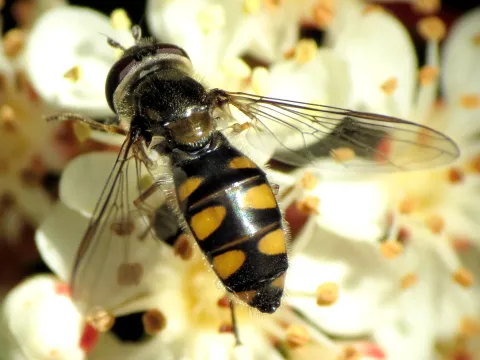
Javanese hoverfly
Ischiodon javanum
The Javanese hoverfly (Ischiodon javanum) belongs to the Syrphidae family, order Diptera. These insects are famous for their ability to hover motionless in the air, resembling miniature helicopters before darting away suddenly.
What the section contains
Javanese hoverfly
Adults are typically 8–10 mm long with striking black and yellow bands on their abdomen, effectively mimicking wasps to deter potential predators. Their wings are clear and very efficient for rapid aerial maneuvers.
The larvae are legless, slug-like creatures, often green or brownish. They lack a distinct head and use a specialized hook-like mouthpart to capture and consume their prey.
Eggs are small, elongated, and white, typically laid singly on the surface of leaves in close proximity to aphid colonies, ensuring an immediate food supply for hatching larvae.
Pupation occurs in a puparium, a hardened shell derived from the final larval skin. This stage is usually attached to stems or the undersides of leaves, protected from environmental stress.
It is crucial to note that the Javanese hoverfly is not a plant pest. Its larvae are voracious predators that play a vital role in biological control by feeding on soft-bodied insects, primarily aphids.
They are frequently observed on various vegetable crops, including cucumbers, zucchini, cabbage, and lettuce. The presence of larvae is actually a sign that the plant is infested with aphids, which attract the hoverfly.
The larvae do not consume plant tissue; they focus entirely on aphid colonies. One larva can consume hundreds of aphids during its development phase, providing significant relief to the plant.
Any damage seen on the plant is caused by the aphids themselves, not by the hoverfly larvae. In fact, the hoverfly helps to mitigate the long-term impact of pest infestations on the crop.
Because they act as natural controllers, they are categorized as beneficial insects in agriculture rather than pests, and their presence should be encouraged in sustainable farming practices.
The Javanese hoverfly is most active during the warmer months, generally from late spring through autumn, whenever temperatures are conducive to insect development, usually above +20°C.
Adults are highly mobile and fly during the day, seeking nectar from flowers and identifying suitable sites to lay eggs near prey populations for their future offspring.
Multiple generations can occur within a single growing season. The speed of the life cycle is directly proportional to the availability of aphids and the prevailing ambient temperatures.
As the season progresses toward winter, activity declines. Larvae mature and pupate, preparing for the transition into the next generation or entering a dormant state if temperatures drop significantly.
In greenhouses or warmer climates, year-round breeding may occur if there is a continuous food source and stable temperatures, making them excellent candidates for greenhouse pest management.
The primary sign of a hoverfly presence is the discovery of slug-like larvae crawling among aphid colonies. They are often found on the undersides of leaves where aphids aggregate.
Small, empty, shriveled aphid skins are a hallmark of hoverfly larval feeding. Once a larva has drained its prey, it moves on to the next one, leaving behind clear evidence of its efficiency.
The presence of hovering adults around flowering borders or vegetable plots is a positive indicator that these beneficial insects are actively patrolling the area for pest infestations.
Elongated white eggs positioned near leaf veins or colonies of aphids indicate that the next generation of predators will soon be hatching to assist in pest suppression.
The absence of plant damage (such as holes or wilting) despite the presence of larvae confirms that the organism on the plant is a beneficial predator rather than a plant-feeding pest.
Control measures are generally not recommended for the Javanese hoverfly because it is a beneficial predator. The goal should be to conserve and support their population to minimize aphid infestations.
Avoid the broad-spectrum use of chemical insecticides, which kill both the aphids and their natural predators, often leading to a resurgence of pest populations due to a lack of natural checks.
Encourage their presence by planting nectar-rich flowers such as dill, coriander, or various wildflowers, which provide essential nourishment for adult hoverflies and increase their lifespan.
Adopt an integrated pest management (IPM) approach. By using selective biological agents, you can protect the predatory larvae while effectively managing primary pest populations.
Regular monitoring of your crops allows you to distinguish between harmful pests and beneficial insects, ensuring that any management actions taken are necessary and do not disrupt the ecological balance.