
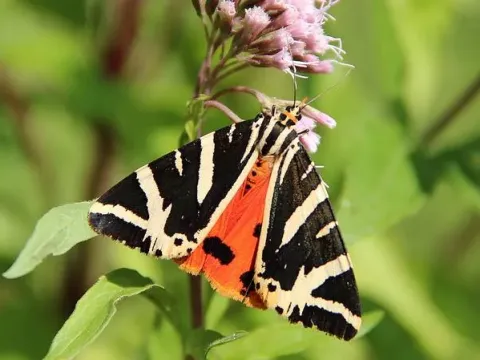
Jersey tiger
Panaxia quadripunctaria
The Jersey tiger moth (Euplagia quadripunctaria) is a member of the Erebidae family. It is a striking nocturnal moth known for its distinctive pattern that serves as an identification key.
What the section contains
Jersey tiger
The forewings are dark with cream-colored diagonal stripes. When at rest, the moth keeps its wings folded roof-like over its body, effectively camouflaging it against tree bark or dry vegetation.
The hindwings are bright red or orange, featuring black spots. This bold coloration is a classic defense mechanism, meant to startle potential predators when the moth suddenly takes flight.
Larvae are dark, hairy caterpillars reaching up to 50 mm in length. Their bodies are covered in dense tufts of hair and row of orange-colored tubercles, which can cause skin irritation if touched.
The life cycle is univoltine, meaning there is only one generation per year. The species overwinters as young larvae, hidden in leaf litter or under organic debris to survive the winter temperatures.
The Jersey tiger is a polyphagous species, meaning it feeds on a wide variety of plants. While primarily a forest-edge inhabitant, it can become a pest when it shifts to cultivated landscapes.
It prefers plants from the Lamiaceae and Asteraceae families. In domestic gardens, it frequently causes damage to raspberry bushes, strawberries, and various herbaceous ornamentals.
The damage is caused by larvae that actively chew on the leaves. They can consume entire leaf sections, leaving only the primary veins, which significantly hampers the plant's photosynthesis process.
Heavy infestations can lead to partial or total defoliation of the plant. This structural damage weakens the plant, making it more susceptible to secondary infections and reducing potential yield.
Young caterpillars often start by skeletonizing leaves, while older, larger larvae consume the entire leaf lamina. This feeding behavior can lead to stunted growth and poor flower or fruit development.
Adult moths are typically active during the summer months, from July through August. They are known for flying both at night and during the day, frequently seen visiting flowers to feed on nectar.
Females lay eggs on the undersides of leaves of host plants. The eggs hatch into small larvae that begin their feeding cycle shortly after, preparing for the upcoming stages of development.
Late summer and autumn are the peak periods for larval growth. During this time, they accumulate necessary energy reserves for the dormant winter period, often hiding in cool, shaded areas.
In spring, as temperatures rise, the overwintered caterpillars become active again. They undergo a final growth spurt before finding a suitable location to pupate as the cycle approaches its conclusion.
Pupation occurs in late spring, typically inside a loose cocoon made of silk and plant fragments. This stage lasts several weeks, culminating in the emergence of a new generation of adults.
Identifying the Jersey tiger moth is easiest by spotting the feeding patterns on the foliage. Look for irregular holes or missing leaf margins that suggest the presence of a chewing pest.
Caterpillar droppings (frass) on leaves or the soil surface underneath the infested plants are clear indicators. Large, hairy, dark caterpillars present on the stems are definitive signs.
Silk webbing may sometimes be found where caterpillars congregate or prepare for molting. This webbing can pull leaves together, creating hidden environments that protect the larvae.
Reduced plant vigor and visible wilting are secondary symptoms. If a plant seems to be losing leaf mass rapidly without obvious signs of disease, check the underside of the leaves.
- Skeletonized leaf patches.
- Large irregular holes in the leaf blades.
- Presence of black, hairy larvae.
- Frass accumulation under the canopy.
Effective management begins with good cultural practices. Keeping the area free of excess weeds and tall grasses reduces the primary habitats where the larvae hide and feed in early spring.
Deep cultivation of the soil in late autumn is highly recommended. This practice exposes overwintering pupae and larvae to frost and natural predators, significantly reducing the local population.
For organic gardening, apply biological controls such as products containing Bacillus thuringiensis. These specifically target caterpillars and are safe for beneficial insects and pollinators.
Chemical intervention should be reserved for severe outbreaks and applied cautiously. Always choose pesticides that are registered for use on the specific crop to avoid damage to sensitive plants.
Encourage natural pest controllers by maintaining biodiversity in the landscape. Birds, spiders, and parasitic wasps are excellent at keeping Jersey tiger moth populations at manageable levels.