
Jersey tiger
Panaxia
The Jersey tiger moth, scientifically known as Euplagia quadripunctaria, belongs to the family Erebidae. It is a striking moth with black forewings featuring creamy white stripes and vivid orange-red hindwings with black spots.
What the section contains
Jersey tiger
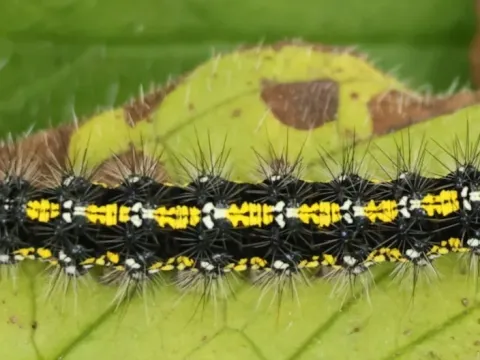
The caterpillars are typically dark, often brownish or blackish, and covered with fine hairs, which serves as a defense mechanism against avian predators.
The life cycle involves a single generation per year. Adults are usually observed flying from July through September, displaying both nocturnal and diurnal activity.
The species is widespread across various habitats, including forest edges, bushy gardens, and damp meadows, which allows it to thrive in diverse environments.
Proper identification is crucial, as its warning colors are meant to signal toxicity to predators, though it remains a nuisance pest for horticultural crops.
The Jersey tiger is a polyphagous pest, meaning the larvae feed on a wide range of host plants, including various herbs, shrubs, and even some fruit trees.
They are known to consume the foliage of plants like hemp-agrimony, nettles, and various fruit-bearing shrubs, leading to significant leaf mass reduction.
In garden settings, these caterpillars can cause aesthetic and physiological damage to ornamental plants and some berry crops if populations reach high levels.
Feeding damage is characterized by ragged leaf edges and skeletonization of leaves, which stresses the plant and inhibits its overall growth and development.
Repeated or severe defoliation can lead to a decrease in fruit yield and vigor in susceptible host plants, necessitating active monitoring and intervention.
Adult moths are typically active during mid-to-late summer, when they mate and lay eggs on the undersides of leaves of suitable host plants.
Caterpillars emerge from eggs and begin feeding, eventually entering a period of overwintering as larvae within the leaf litter or near the base of plants.
Spring activity resumes once temperatures rise, with larvae feeding on fresh spring foliage until they reach the pupal stage in early summer.
Pupation usually occurs in June or July, protected within a loose silken cocoon among leaves or in the soil surface layer, followed by adult emergence.
The seasonal peaks of damage occur during the early spring feeding phase and the secondary growth phase in the autumn, prior to winter dormancy.
Primary signs of infestation include visible feeding damage on leaves, such as large, irregular holes or notches eaten from the margins of the leaf blades.
The presence of frass, or larval droppings, on the leaves or the soil surface beneath the plants is a clear indicator of active caterpillar feeding.
Observation of dark, hairy larvae on the undersides of leaves during the early morning hours provides confirmation of the pest presence.
Damage is often most concentrated on weeds surrounding a garden, which then acts as a bridge for the larvae to move onto crops like strawberries or fruit bushes.
Leaves showing signs of skeletonization, where the soft tissues are removed leaving only the tougher veins, are indicative of younger larval colonies.
Cultural control practices, such as maintaining weed-free borders, can significantly reduce the habitat available for larval development near crops.
Hand-picking caterpillars in small gardens is an effective and environmentally friendly method, particularly when larvae are still small and concentrated.
Biological control using Bacillus thuringiensis sprays can target the caterpillars specifically without causing harm to beneficial garden insects or pollinators.
For large-scale infestations, authorized horticultural insecticides applied during the early larval stage provide the most reliable results in crop protection.
Sanitation measures, including the removal of leaf litter in the autumn, help destroy overwintering sites, significantly decreasing the population for the following year.